
DSO calculator
Free DSO calculator: calculate your debtor days
How much of your business's cash is sitting in unpaid customer invoices?
Use our free DSO calculator to calculate your Days Sales Outstanding (also known as debtor days), compare your result with your payment terms and estimate how much cash you could potentially release by collecting payments sooner.
No email address, registration or spreadsheets required.
CALCULATE YOUR DSO
Use our free DSO calculator
Enter your outstanding trade receivables and credit sales for the same reporting period. Our days sales outstanding calculator will work out your DSO, show your average daily credit sales and help you understand the potential cash impact of reaching your target.
Free UK business tool
Calculate your DSO
Get your debtor days, compare them with your terms and estimate what faster collections could release in cash. No sign-up required.
Your DSO result
DSO uses a receivables snapshot and credit sales for the selected period. It estimates days' worth of sales outstanding, not the lateness of individual invoices. Cash released is illustrative and assumes comparable sales levels and accounting treatment. Review your aged debt report for the actual invoices requiring action.
Keep VAT treatment consistent between receivables and credit sales. Figures are calculated in your browser; the calculator sends no financial values to analytics.
How to calculate DSO
The Days Sales Outstanding formula is:
DSO = (accounts receivable ÷ total credit sales) × number of days in the period
You’ll need three figures:
Accounts receivable: What customers owe your business at the end of the reporting period.
Total credit sales: Sales made on credit during that period, excluding sales paid immediately.
Reporting period: The number of days covered by your sales figure, such as 30, 90 or 365.
Make sure your receivables and sales figures use a consistent VAT basis. Mixing VAT-inclusive debtors with VAT-exclusive sales can distort the result.
DSO calculation example
Let’s say your business has £50,000 in outstanding trade receivables and £500,000 in annual credit sales.
£50,000 ÷ £500,000 × 365 = 36.5 days
Your outstanding receivables represent approximately 36.5 days of credit sales.
This is a useful estimate of your collection cycle. Individual customers may pay earlier or later, so the result needs to be considered alongside your aged debtor report.
What your DSO result means
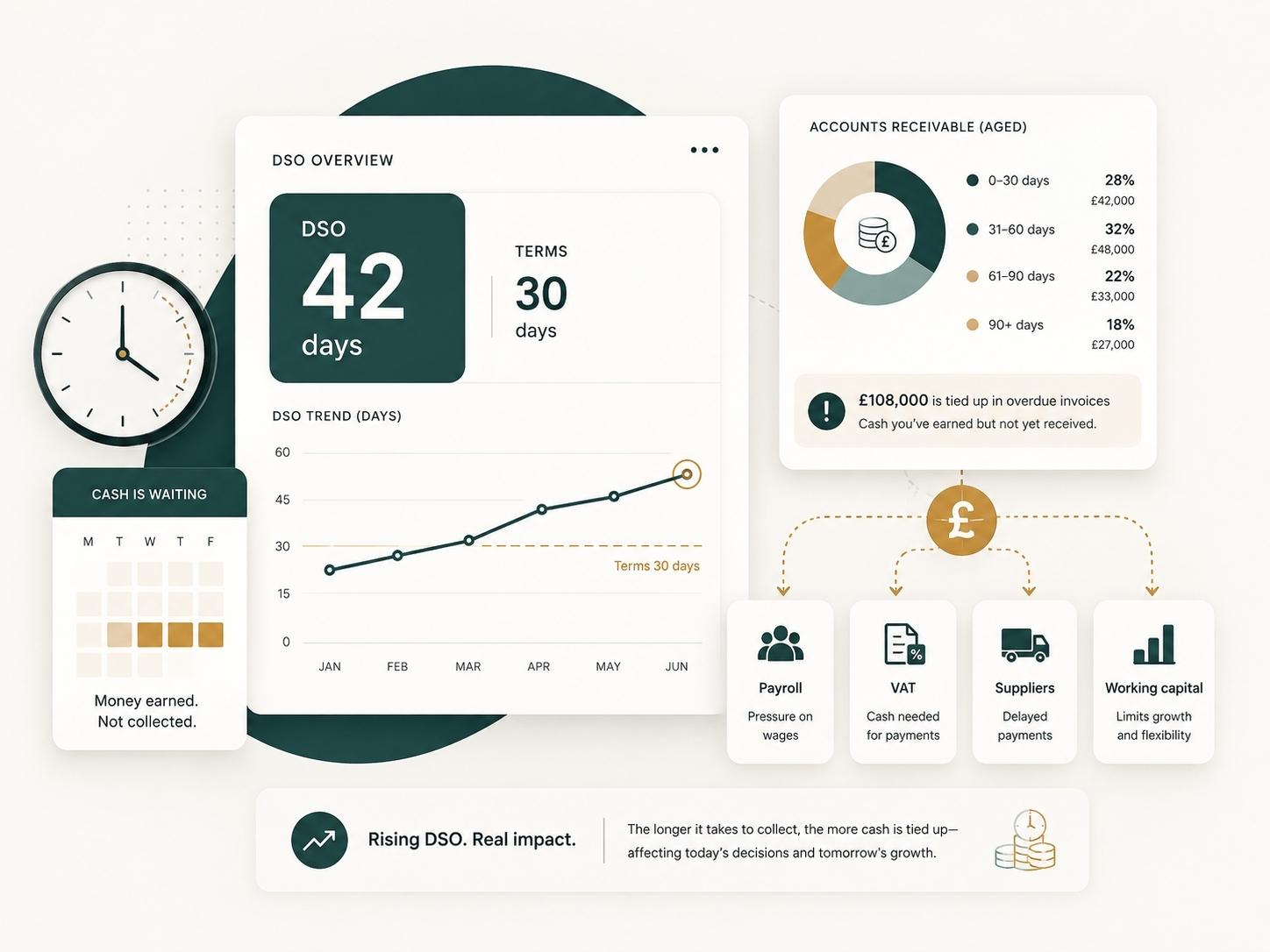
Your Days Sales Outstanding indicates how much of your credit sales remains tied up in unpaid customer balances, expressed in days.
A rising DSO can mean more cash is sitting in receivables. But the figure is influenced by payment terms, sales volumes, seasonality and customer mix.
The most useful starting point is to compare your result with three things:
Your agreed payment terms. Are you offering 30-day terms but consistently recording a much higher DSO?
Your previous results. Is the collection cycle improving, remaining stable or getting longer?
Your aged debtor report. Which customers and invoices account for the outstanding balances?
What is a good DSO for a UK business?
There isn’t a single ideal DSO for every business.
A company working on large contracts with staged payments may have a different collection cycle from a business issuing smaller monthly invoices.
If most of your customers have 30-day terms and your DSO is 50 days, it’s worth investigating why the difference exists. It doesn’t automatically mean every invoice is being paid 20 days late.
I’d focus on understanding your normal payment cycle, establishing a consistent baseline and investigating meaningful changes.
Why DSO matters to your cash flow
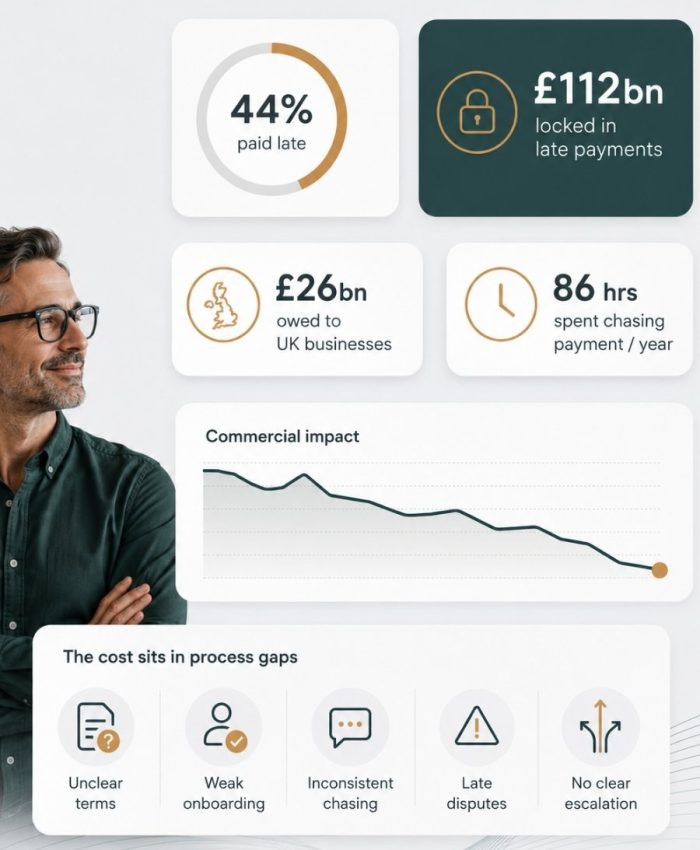
A business can generate healthy sales while struggling to meet its own payment commitments because customer invoices remain outstanding.
That can affect supplier payments, payroll, VAT and the money available for investment.
Take our earlier example:
Annual credit sales: £500,000
Current DSO: 36.5 days
Target DSO: 30 days
Average daily credit sales: approximately £1,370
Reducing DSO by 6.5 days could bring forward approximately £8,904 in cash, assuming sales remain at a comparable level.
That’s an indicative working capital benefit. It represents money collected sooner, rather than additional revenue or profit.
Your calculator can estimate this potential cash release when you enter a target DSO.
WHAT SITS BEHIND THE NUMBER
What causes a high DSO?
If your debtor days are consistently higher than expected, I’d start by investigating what’s happening between agreeing a sale and receiving payment.
The problems are often quite ordinary. That’s why they can persist for months.
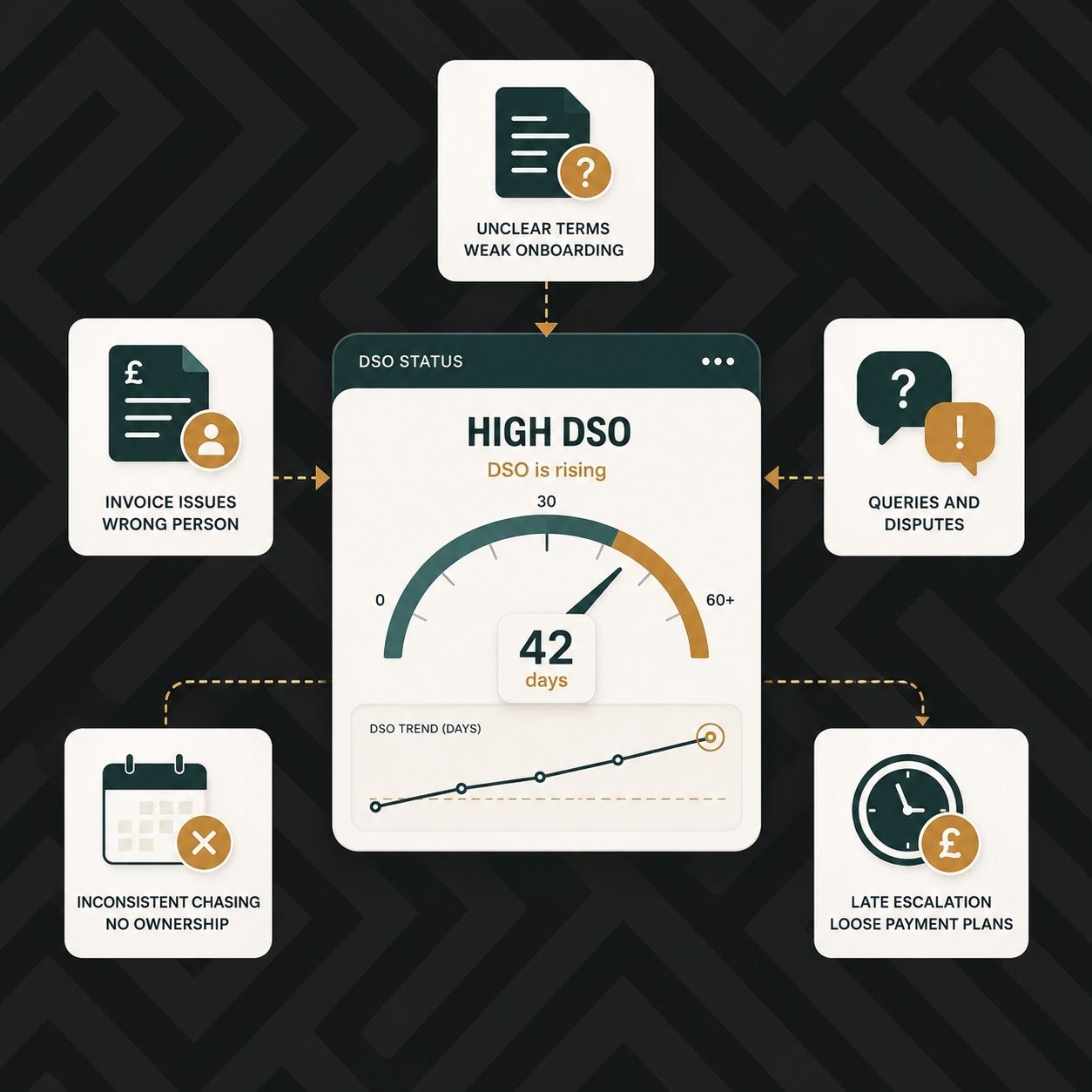
Unclear payment terms: Customers haven’t properly agreed when payment is due or what’s required to process it.
Late or incorrect invoicing: Work has been completed, but invoices are delayed, contain errors or go to the wrong contact.
Missing purchase orders: The customer’s accounts payable team can’t process an invoice because required information is missing.
Unresolved disputes: An invoice remains outstanding while finance, sales or operations wait for somebody else to resolve a query.
Inconsistent chasing: Reminders depend on who has time, and overdue accounts can go weeks without meaningful action.
Broken payment promises: Customers commit to payment dates, but missed commitments aren’t followed up promptly.
Poor escalation: Accounts become progressively older without a clear decision about what happens next.
Changes in sales patterns can also move DSO, even when individual customers’ payment behaviour hasn’t changed.
My advice is to identify the customers and invoices behind the number before changing your collection strategy.
An aged debtor report will help you understand which balances need attention and what action should follow.
How to reduce DSO
Improving your Days Sales Outstanding starts with understanding where invoices are getting delayed. A staggering 49% of UK SME invoices were overdue in early 2026, according to Sage research using accounting data from nearly 150,000 businesses.
Here’s where I’d focus first.
1. Investigate your largest overdue balances
Review your aged debtor report. Identify high-value overdue invoices, long-standing disputes and customers repeatedly missing payment commitments. Give each account a clear next action.
2. Check what happens before an invoice is due
Confirm payment terms, purchase order requirements, invoice contacts and customer approval procedures. An invoice that can’t be processed correctly is already at risk of late payment.
3. Improve the timing and accuracy of invoicing
Send invoices as soon as the agreed billing trigger is reached. Check that the information is correct and the invoice has reached the right person.
4. Establish a consistent credit control process
Decide when reminders are sent, who makes follow-up calls, how payment promises are recorded and when an overdue account needs escalation.
5. Measure progress monthly
Recalculate DSO using a consistent method. Monitor the total value of overdue invoices, ageing by 30, 60 and 90+ days, disputed balances and repeat late-paying customers.
Look for patterns. If the same accounts or issues keep appearing, investigate the underlying cause.
For more detailed guidance, read our article on how to reduce late payments: 10 practical steps for UK SMEs.
FIND THE RIGHT NEXT STEP
If your DSO needs attention, start here
Your DSO tells you how much of your credit sales remains outstanding. The next step depends on what’s causing the delay.
Aged debt action plan
Several invoices are already overdue.
Get a structured review of your aged debt, a prioritised action plan, practical chasing templates and support to help your team pursue payment.
Credit control review & setup
Customers keep paying late, despite repeated chasing.
We review the process behind getting paid, from customer setup and payment terms through invoicing, disputes, chasing and escalation. Identify where payments are being delayed and what needs changing.
Credit control
training
Your team needs to handle collections more effectively.
Practical training for people responsible for chasing payment, dealing with customer excuses, resolving disputes and knowing when to escalate.
PRACTICAL CREDIT CONTROL ADVICE
Want to get your DSO down?
If you’re dealing with slow-paying customers, overdue invoices or a growing aged debtor report, a clearer credit control process can make a difference.
Join the Collect Wise newsletter for occasional practical advice on reducing late payments, handling difficult payment conversations and getting invoices paid when they’re due.
Things You Need to know
Frequently Asked Questions
What is a DSO calculator?
A DSO calculator estimates Days Sales Outstanding using your trade receivables, credit sales and reporting period. It helps you understand how much of your credit sales remains outstanding and monitor changes in your collection cycle.
Is DSO the same as debtor days?
Yes. Days Sales Outstanding (DSO) and debtor days are commonly used interchangeably. Both describe the relationship between outstanding customer receivables and credit sales, expressed in days.
Should I calculate DSO monthly or annually?
Both are useful. A monthly calculation helps you monitor changes more frequently, while an annual calculation provides a broader view.
Use credit sales from the same reporting period and apply a consistent method when comparing results. Shorter periods can be more sensitive to seasonal fluctuations or large invoices raised near month-end.
Should I include VAT when calculating DSO?
Your trade receivables and credit sales should be calculated on a consistent basis.
For example, using VAT-inclusive trade receivables with VAT-exclusive sales can overstate DSO. Check how the figures are recorded in your accounting system before calculating.
How do you calculate DSO?
Divide accounts receivable by credit sales for the period, then multiply by the number of days in that period.
Can DSO increase even if customers are paying on time?
Yes. Changes in sales volumes, customer mix, contract terms and the timing of invoices can affect your DSO. Look at trends alongside the value and age of outstanding receivables before drawing conclusions.
Is a DSO calculation the same as an aged debt analysis?
No. DSO measures outstanding receivables relative to credit sales. An aged debtor report identifies individual unpaid invoices, their due dates and how long balances have been outstanding.
Together, they help you understand the overall collection cycle and which accounts require action.
Does reducing DSO increase profit?
Reducing DSO can improve working capital by bringing customer payments forward. It doesn’t automatically increase sales or profit.
There may be separate financial benefits, such as lower financing requirements or fewer bad debts, depending on the business and the changes made.
Is DSO the same as aged debt?
No. DSO measures the relationship between outstanding receivables and sales across a period. An aged debtor report shows which specific invoices remain unpaid and how long they have been outstanding.
Can Collect Wise help reduce DSO?
Yes. Collect Wise helps SMEs review aged debt, improve credit control processes, set up clearer chasing routines and train teams responsible for collecting payment.