

What is credit management? For an SME, it is the process used to decide who receives credit, what payment terms apply and how the business makes sure invoices are paid when they become due.
It covers the full journey from assessing a customer before offering credit through to invoicing, monitoring payment, resolving disputes and escalating overdue accounts.
For an SME, that covers far more than chasing overdue invoices.
Good credit management starts before the sale. It includes deciding whether a customer should receive credit, agreeing appropriate payment terms, invoicing correctly, monitoring what is outstanding, dealing with queries quickly and knowing when an unpaid invoice needs to be escalated.
When those individual pieces work together, businesses have much greater control over when sales turn into cash.
Research from the Office of the Small Business Commissioner found that more than 1.5 million UK businesses are affected by late payments each year, with an estimated £26 billion owed in late payments at any given time.
Late payment is widespread. Accepting it as inevitable is where the problems start.
What is credit management and what does it include?
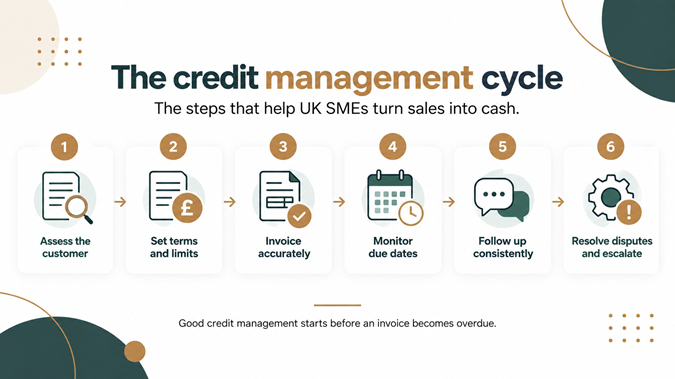
A practical credit management process follows the customer from the point at which you decide to trade with them through to the point at which their invoice is paid.
That usually includes:
- Assessing the customer before offering credit. This might include credit checks, references, Companies House information, previous payment behaviour and your own assessment of the commercial risk.
- Setting appropriate credit terms and limits. How much credit will you extend? How long does the customer have to pay? What happens if they exceed their limit or fail to pay?
- Making payment expectations clear. Your terms need to be agreed, understood and reflected consistently in contracts, quotations and invoices.
- Getting invoices right first time. Correct legal entity, purchase order, billing contact, description, amount, VAT details and payment instructions all matter. Small errors create easy reasons for payment to be delayed.
- Monitoring outstanding invoices. Someone needs visibility of what is due, what is overdue, what has been promised and what has been disputed.
- Following a consistent chasing and escalation process. Reminders, calls, promises to pay, disputes, payment plans and formal escalation all need clear triggers rather than being dealt with differently every time.
The individual tasks aren’t particularly complicated. Problems usually arise when nobody has connected them into one consistent process.
Credit management vs credit control: what’s the difference?
The terms credit management and credit control are often used interchangeably, particularly within smaller businesses.
There is a useful distinction, though.
Credit management is the wider framework. It considers who should receive credit, the level of risk the business is willing to take, the terms offered, how outstanding credit is monitored and how payment risk is controlled.
Credit control is generally the day-to-day activity that puts that framework into practice, including issuing invoices, monitoring due dates, sending reminders, making collection calls, following up payment promises and escalating overdue accounts.
In a large business these responsibilities may sit across different departments.
In an SME, they might all sit with one finance administrator, bookkeeper, office manager or business owner.
That makes having a clear process more important.
Why is credit management important?
Understanding what is credit management across your own business helps you spot where payment delays, credit risk and collection problems are being created.
Making a sale doesn’t put cash in the bank.
If you provide a product or service today and allow the customer 30 days to pay, your business is effectively financing that customer until payment arrives.
If they take 45, 60 or 90 days instead, you continue carrying that cost.
Multiply that across dozens of customers and the difference between reported revenue and available cash can become substantial.
Effective business credit management helps you control that gap.
It can help you reduce overdue debt, spot payment problems earlier, make better decisions about extending credit, resolve invoice issues faster and produce more reliable cash-flow forecasts.
There is also a less obvious benefit: consistency.
When customers know when invoices arrive, when reminders are sent and what happens if they don’t pay, there is less room for ambiguity.
The point many SMEs miss: late payment often starts before the invoice is overdue
One of the most common credit-control mistakes is treating the due date as the beginning of the payment process.
By then, several things may already have gone wrong.
The payment terms were never properly agreed.
Nobody checked whether the customer needed a purchase order.
The invoice went to the wrong person.
The customer had a query but nobody owned it internally.
The account exceeded its agreed credit limit.
A promised payment wasn’t recorded or followed up.
Nobody contacted the customer until the invoice was already several weeks overdue.
Then somebody in finance is expected to fix everything by sending increasingly firm reminder emails.
From our experience recovering more than £25 million in debt and working with hundreds of organisations, persistent late payment is frequently a process problem before it becomes a collections problem.
That’s why repeatedly changing the wording of your reminder emails rarely fixes recurring late payment on its own.
You need to look further upstream.
What should a good credit management process look like?
There isn’t one perfect credit management process for every business.
A company sending five large invoices each month will need something different from a company raising hundreds of smaller invoices.
But the fundamentals should be clear.
Before you trade
Decide what information you need from a new customer, whether a credit check is required and what credit limit and payment terms are appropriate.
Make sure the person agreeing the sale understands those requirements too.
Sales and credit decisions shouldn’t operate completely separately. A large order isn’t necessarily a good order if the business has little confidence it will be paid.
Before you invoice
Confirm who receives invoices, whether a purchase order is required and whether the customer’s accounts-payable process has any specific requirements.
This can feel administrative until a £20,000 invoice sits unpaid because it is missing a PO number.
When you invoice
Send invoices promptly and accurately.
Check that the invoice has been received where necessary, particularly for new or high-value customers.
Waiting until the due date to discover that the invoice went to an old email address is avoidable.
Before payment becomes overdue
Credit management doesn’t need to begin with a threatening overdue notice.
For appropriate accounts, a polite reminder before the due date can confirm that the invoice is scheduled for payment and surface problems early.
A customer telling you on day 27 that they need a copy purchase order is much easier to deal with than discovering it on day 47.
When payment becomes overdue
Have a defined chasing sequence.
Your team should know when to email, when to call, how promises to pay are recorded and followed up, and when an account needs firmer action.
The process should also distinguish between a customer who has temporarily missed a payment and one repeatedly breaking agreed terms.
When there is a dispute
Treat invoice disputes separately from ordinary late payment.
A disputed invoice needs an owner, a reason, evidence and a deadline for resolution.
Allowing disputes to sit in somebody’s inbox for six weeks while the debtor ledger continues ageing is one of the easiest ways for recoverable money to become harder to collect.
When escalation is required
Your team should know when ordinary chasing stops.
That might mean placing the account on hold, agreeing a formal payment plan, issuing a final demand, considering statutory interest and compensation where applicable, or moving the debt towards formal recovery.
Without agreed escalation points, businesses often repeat the same chasing activity for far too long.
How do you know if your credit management needs improving?
Look at what happens repeatedly.
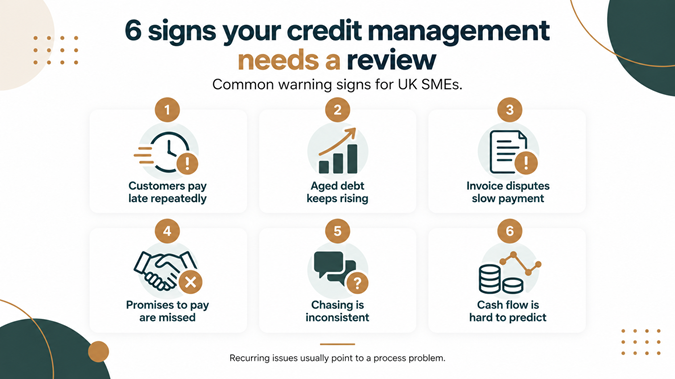
Customers regularly paying beyond agreed terms is one sign.
So is an increasing aged-debt balance, frequent invoice disputes, broken promises to pay, inconsistent chasing or senior people repeatedly having to step in to get invoices paid.
Another useful measure is your Days Sales Outstanding, or DSO.
DSO gives you an indication of how long, on average, it takes your business to collect payment after making a sale on credit.
The number alone won’t tell you what is wrong, but movement in the wrong direction is a useful signal that something in the payment process deserves attention.
A credit policy needs to work in practice
Many businesses technically have a credit policy.
Far fewer have one that people consistently use.
A document saying customers receive 30-day terms doesn’t help much when sales staff routinely agree something different, invoices aren’t sent promptly and nobody knows when an overdue account should be placed on hold.
A useful credit policy should reflect how the business genuinely trades.
It should make decisions easier by setting out who can approve credit, how limits are set, what terms apply, who owns each stage of the payment process and what happens when the rules aren’t followed.
The test is simple: could somebody in your business use it tomorrow to make a clear decision about a customer account?
If the answer is no, it probably needs work.
Better credit management gives you more control over cash
You can’t guarantee that every customer will pay exactly on time.
Customers experience financial problems. People make mistakes. Disputes happen.
What you can control is how much unnecessary delay your own process creates and how quickly your business responds when payment goes off track.
That’s the purpose of good credit management.
Clear terms. Accurate invoices. Defined ownership. Consistent follow-up. Fast dispute resolution. Sensible escalation.
Get those pieces right and fewer invoices should reach the point where somebody has to repeatedly chase them.
Does your credit management process need a review?
If customers repeatedly pay late, invoices are being disputed after they become overdue or chasing depends on whoever has time to do it, the underlying process is worth examining.
Collect Wise’s Credit Control Review & Setup looks at the complete payment process, including customer onboarding, payment terms, invoicing, chasing, disputes and escalation.
We identify where payment is being allowed to drift and help you put a practical credit control process in place that your team can manage consistently in-house.