

How to chase an overdue invoice comes down to having a clear sequence and knowing what you need from each conversation.
You don’t need seventeen versions of a payment reminder. You need to establish why the invoice hasn’t been paid, who can get it paid and exactly what happens next.
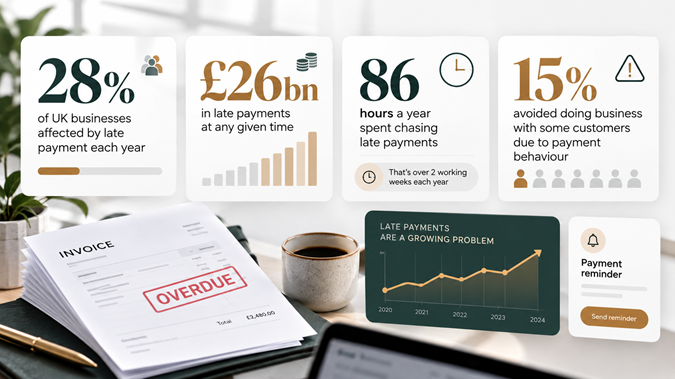
That sounds simple. Yet UK businesses affected by late payments spend an average of 86 hours a year chasing them. Government research also estimates that businesses are owed around £26 billion in late payments at any given time.
I’ve spent more than two decades working in credit management and previously built a credit management business that recovered more than £25 million for clients. One thing hasn’t changed much: overdue invoices become harder to collect when nobody takes control of the conversation.
Here’s the process I’d use.

How to chase an overdue invoice in 8 steps
1. Check the invoice before you chase it
Before contacting the customer, make sure the invoice is genuinely payable.
Check the invoice number, amount, customer details, purchase order number where required, payment terms, due date and the email address or portal it was submitted to.
Also check whether anything is already happening internally.
Has the customer raised a query with sales? Has somebody agreed different payment terms? Was a credit note promised? Has the account manager told them they can pay next month?
You want the facts before you contact the customer.
The Small Business Commissioner specifically recommends checking that invoices contain the information the customer needs to process them, including the invoice date, number, PO number where applicable, payment due date, agreed payment terms and bank details.
This first check matters because chasing an invoice that your customer cannot approve wastes everybody’s time.
2. Chase as soon as the invoice becomes overdue
I wouldn’t leave an overdue invoice sitting for two weeks because you don’t want to appear pushy.
If payment was due on Friday and it hasn’t arrived, follow it up.
Early contact is usually easier because you’re dealing with a recent invoice and a relatively small delay.
Your first message can be straightforward:
Hi Jane, invoice 1842 for £3,750 was due for payment on 23 September. Please can you confirm that it has been approved and what date payment is expected?
That does three useful things.
It identifies the invoice, states that it is overdue and asks for a payment position.
Compare that with:
Just checking whether you’ve had a chance to look at the attached invoice?
I see versions of that constantly.
It sounds polite, but it asks very little of the customer.
You already know the invoice exists. What you need to know is when it will be paid.
3. Find the reason for non-payment
Once an invoice is overdue, I’m trying to establish which problem I’m dealing with.
The customer may never have received the invoice. It could be awaiting approval. There may be a PO issue. They may dispute part of the work. Their payment run may have been missed. The invoice has gone to the wrong address. They may have cash-flow problems. Or they may simply be delaying payment.
Those situations need different responses.
“Accounts are looking into it” isn’t enough information to manage the debt properly.
Ask specific questions.
Who is approving the invoice?
Has it been approved?
Is anything preventing payment?
Which payment run will it be included in?
What date should the money reach our account?
Good credit control is partly investigation. The quicker you identify the blockage, the quicker you can deal with it.
4. Stop relying on email when email stops working
Email is useful. It gives you a record of what has been said and works perfectly well for routine reminders.
But an inbox can also become a very comfortable hiding place for an overdue invoice.
If you’ve emailed and aren’t getting a meaningful response, call.
My preference is to move to a conversation sooner rather than continuing to send increasingly stern versions of the same message.
Keep the call factual:
“I’m calling about invoice 1842 for £3,750, which was due on 23 September. I wanted to establish what is holding the payment up and agree when we can expect it.”
Then listen.
You’re trying to find the obstacle.
If they say, “It’s with finance”, ask who in finance.
If they say, “It should be paid soon”, ask for the payment date.
If they say, “I need to speak to the director”, agree when they’re doing that and when you’ll speak again.
The Small Business Commissioner recommends being assertive while remaining professional and investigating the cause of the delay rather than assuming why payment hasn’t been made.
The tone can stay perfectly civil while the questions become increasingly specific.
5. Turn promises into dates
One of the most common weaknesses I see in credit control notes is this:
Customer promised payment.
When?
“Soon.”
That isn’t a payment promise.
A useful commitment has a date attached to it.
If the customer says they will pay next week, ask:
“What date will you be making the payment?”
Then confirm it in writing.
Thanks for speaking with me today. As agreed, payment of £3,750 against invoice 1842 will be made on Thursday 1 October. I’ll check the account on Friday and come back to you if it hasn’t arrived.
Now everybody knows what was agreed.
Record the commitment and schedule your follow-up immediately.
Don’t wait another fortnight after a broken promise before starting again.
A broken payment promise is information about the account.
6. Deal with disputes separately
A disputed invoice needs investigation.
That doesn’t mean the entire account should disappear into a black hole labelled “query”.
Find out:
What is being disputed?
How much is disputed?
What evidence does the customer need?
Who within your business can resolve it?
When will they do it?
If £500 of a £10,000 invoice is genuinely disputed, consider whether the undisputed balance can be paid while the £500 is investigated.
This is an area where businesses frequently lose control.
The query gets passed to another department and the credit controller assumes somebody else is dealing with it.
Three weeks later, the invoice is still unpaid.
Give the dispute an owner and a deadline.
And look for patterns. A customer who raises a new query every time an invoice becomes due may need a different credit-control approach from a customer with one legitimate problem.
7. Escalate when normal chasing stops producing results
There needs to be a point where chasing becomes escalation.
Exactly when depends on the debt, customer, history, contractual position and circumstances.
Escalation might include contacting a more senior person, involving the customer’s procurement or finance lead, placing the account on stop where your contract and commercial circumstances allow, issuing a formal final demand or beginning formal recovery.
My rule is simple: never threaten an action you aren’t prepared to take.
Repeated emails saying “further action may follow” lose their effect when nothing ever follows.
Your escalation should have a clear reason and a clear next step.
For example:
Invoice 1842 for £3,750 remains outstanding despite our previous correspondence and the agreed payment date of 1 October. Please arrange payment by 8 October or contact us immediately if there is a specific reason why payment cannot be made. If we don’t hear from you, we’ll move the account to the next stage of our recovery process.
It is factual, controlled and easy to understand.
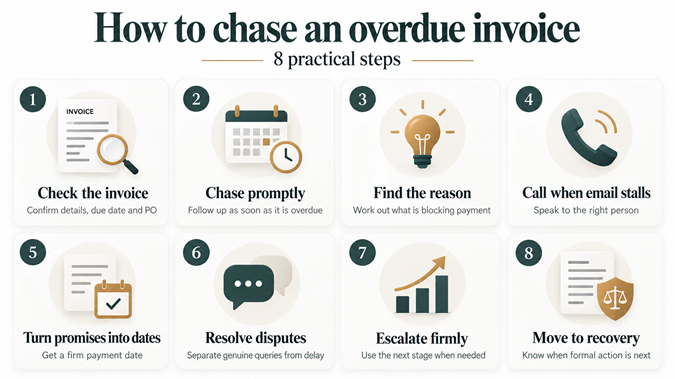
8. Know when to move to formal recovery
Some invoices aren’t going to be resolved by another reminder.
Before formal action, make sure your paperwork is in order. You should be able to evidence what was supplied, what was agreed, the amount due, the payment terms, the invoices, any disputes and the collection history.
For qualifying business-to-business transactions, UK legislation may also allow you to charge statutory interest at 8% above the Bank of England base rate, unless your contract provides a different interest rate. Fixed late-payment compensation can also apply at £40, £70 or £100 per invoice, depending on the value of the debt.
Check the contractual and legal position before adding charges.
There is also an important distinction when formal proceedings are being considered.
The Pre-Action Protocol for Debt Claims applies where a business is claiming a debt from an individual, including a sole trader. It doesn’t apply to ordinary company-to-company debts. Under the Protocol, the debtor normally has 30 days to respond to a Letter of Claim before proceedings can begin, subject to the other requirements of the Protocol.
There is also an imminent procedural change worth knowing. From 1 October 2026, the Protocol is being amended so that Letters of Claim must also be sent by email where appropriate.
Formal recovery is where accuracy matters. If you’re unsure about the process or legal position, take appropriate professional advice before issuing proceedings.
What should you say when chasing an overdue invoice?
Keep it shorter than you probably think.
I’d focus every chase around four pieces of information:
Invoice. Amount. Due date. Action.
For example:
Hi James, invoice 5821 for £6,200 fell due on 15 September and remains outstanding. Please confirm whether it has been approved and the date payment will reach our account.
No long preamble.
No apology for contacting them.
No paragraph explaining how much you value their custom before mentioning the money.
They owe an invoice. You’re asking about its payment.
Professionalism comes from how you handle the conversation, not from softening the message until the purpose disappears.
** Side note – I often ask “How are you?” – first it’s nice to be nice, second it requires a response….
How often should you chase an overdue invoice?
There isn’t one chasing schedule that suits every business.
A £150 invoice from a reliable customer requires different judgement from a £40,000 invoice from a new customer who has already ignored three messages.
Your process should still define a default rhythm.
For example, first contact immediately after the due date, a follow-up if no response is received, a telephone call when email isn’t moving the matter forward, and progressively firmer escalation where agreed actions or payment promises are missed.
Then apply judgement.
What I wouldn’t recommend is opening your aged debtor report once a month and chasing everything in one large batch.
Effective collections depend on follow-up.
If somebody promised payment on Thursday, check on Friday.
If somebody promised an answer tomorrow, diarise tomorrow.
If somebody asked you to call back at 2pm, call back at 2pm.
This sounds basic because it is.
It’s also where a surprising amount of debt recovery falls apart.
Will chasing payment damage the customer relationship?
Handled badly, it can.
Handled professionally, a payment conversation is a normal part of doing business.
The government’s own late-payment research found that 15% of surveyed businesses had avoided doing business with particular customers because of their payment behaviour.
Payment behaviour affects commercial relationships from both sides.
I’d be far more concerned about a business repeatedly supplying a customer who ignores agreed payment terms than about making a professional telephone call concerning an overdue invoice.
Stay factual. Keep proper records. Resolve legitimate issues. Do what you say you will do.
That is usually a better basis for a commercial relationship than allowing resentment to build while invoices remain unpaid.
The credit-control note I want to see
When somebody else opens the customer account, they should be able to understand what is happening within seconds.
Something like:
24 September: Spoke to John in Accounts Payable. Invoice approved. Missed Tuesday payment run. Confirmed for payment 29 September. Sarah advised funds should clear 30 September. Follow up 1 October if not received.
That tells me something.
“Chased customer” tells me almost nothing.
Your notes should capture who you spoke to, what they said, what was agreed and when you need to act again.
That discipline becomes increasingly important when several people are involved in collections.
My advice if the invoice is already badly overdue
Start with the facts.
Don’t begin by sending the angriest email you can write because the invoice is 90 days late.
Establish whether the debt is acknowledged, whether there is a dispute, what previous promises have been made and whether the customer appears able to pay.
Then decide the next appropriate action.
An old invoice often needs a more deliberate collection plan because the easy opportunities to get it paid may already have been missed.
That is also the point where repeatedly “chasing” can become expensive in its own right.
Knowing when to stop repeating the same action is part of good credit control.
Need a clearer plan for an overdue invoice?
If you have an unpaid invoice and aren’t sure what to check, what to say or when to escalate, start with the Collect Wise Overdue Invoice Checklist.
For businesses with several overdue accounts or an ageing debtor ledger, the Aged Debt Action Plan & Templates provides a structured recovery plan and the documents needed to work through the debts yourself.
And if late payment keeps happening across the business, the problem may sit earlier in the credit-control process. Our Credit Control Review & Setup looks at payment terms, invoicing, communications, escalation and the routines behind your collections.