

Accounts receivable management is the process of managing the money customers owe your business, from agreeing payment terms and issuing invoices through to monitoring payment, resolving queries and following up overdue accounts.
For an SME, getting this right has a direct effect on cash flow.
The sale may have happened. The work may have been delivered. Revenue may already appear in the accounts. The cash still has to arrive.
UK businesses are estimated to be owed around £26 billion in late payments at any given time, while businesses affected by late payment spend an average of 86 hours a year chasing money they are already owed.
Good accounts receivable management gives you much greater control over that journey.

What is accounts receivable management?
Accounts receivable, often shortened to AR, is the money customers owe your business for products or services you’ve already supplied on credit.
Accounts receivable management covers the processes used to turn those outstanding invoices into collected cash.
That includes:
- deciding which customers receive credit and on what terms
- capturing the correct billing information
- raising accurate invoices promptly
- monitoring invoice due dates
- checking that payment is progressing
- resolving invoice queries
- recording and following up promises to pay
- escalating overdue accounts when required
In smaller businesses, those responsibilities may sit with an accounts assistant, bookkeeper, office manager, finance manager or the owner.
Whatever the job title, somebody needs clear ownership of the process.
Why accounts receivable management matters
Poor accounts receivable management creates a gap between making a sale and receiving the money.
That gap can become expensive.
You still have staff, suppliers, tax, software, rent and other operating costs to pay while waiting for customers to settle their invoices.
Late payment is also widespread. Research from the Office of the Small Business Commissioner estimates that more than 1.5 million UK businesses are affected by late payment each year.
For me, the more useful question is what your business can control.
You can’t dictate every customer’s financial position or internal payment timetable. You can control your terms, customer setup, invoicing, follow-up, dispute management, record keeping and escalation.
Those areas deserve attention before another reminder email is sent.
Late payment often starts before an invoice becomes overdue
This is one of the biggest things we’ve learned from years of managing credit and collections.
Businesses often focus their attention on an invoice once it appears on the overdue report.
The cause can sit much earlier in the process.
Perhaps the purchase order was never obtained.
The invoice went to the wrong billing contact.
Thirty-day terms were assumed rather than agreed.
A customer query sat unanswered.
The invoice contained incorrect information.
Nobody confirmed that the invoice had reached the customer’s accounts payable system.
A payment promise was recorded somewhere and never followed up.
Each issue adds delay.
By the time the invoice is 30 days overdue, the credit-control team may be dealing with a problem that began weeks or months earlier.
Effective accounts receivable management therefore needs to follow the whole payment journey.
How to improve accounts receivable management
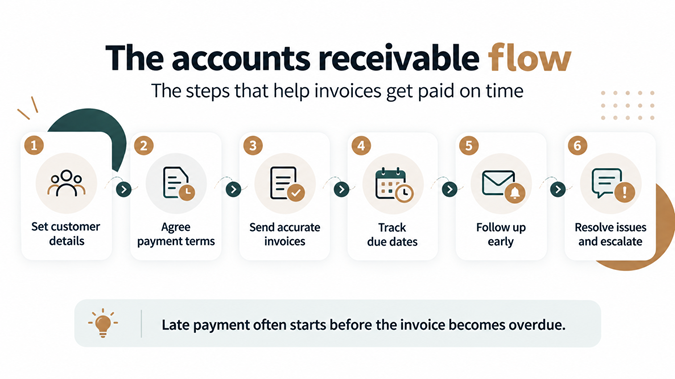
1. Get the customer setup right
Collect the information you need before the first invoice is raised.
That may include the legal business name, billing address, accounts payable contact, purchase-order requirements, invoice submission process and agreed payment terms.
For higher-risk customers, credit checking and appropriate credit limits should form part of the decision.
This information often lives across emails, CRM notes, finance systems and people’s heads.
Put it somewhere your team can use it.
2. Agree payment terms before work starts
Payment terms should be clear and agreed as part of the commercial relationship.
State when payment is due, how invoices will be submitted and any information the customer requires before payment can be authorised.
Also consider whether every customer should automatically receive the same terms.
A long-standing customer with strong payment history presents a different level of risk from a new business placing a large first order.
Payment terms are part of your credit decision.
3. Invoice promptly and accurately
Every unnecessary delay in issuing an invoice moves the eventual payment date further away.
Raise invoices promptly once the relevant work, milestone or delivery has been completed.
Then check the basics.
Is the legal entity correct?
Is the purchase-order number included?
Has the invoice gone to the right person or portal?
Does it show a clear due date?
Are the bank details correct?
Does the description match what the customer expects to see?
These details sound mundane. In practice, they are common reasons for invoices sitting unpaid.
4. Know what’s due before it becomes overdue
Your debtor ledger shouldn’t come as a surprise at month end.
Review upcoming payments regularly.
For larger invoices, new customers or accounts with a history of paying late, pre-due contact can be useful.
A simple confirmation that the invoice has been received, approved and scheduled for payment can uncover a problem while there is still time to fix it.
This also gives you better information for cash-flow forecasting.
5. Give every outstanding invoice a next action
This is one of the disciplines I consider fundamental.
A useful debtor ledger tells you what happens next on every account.
An invoice might be:
awaiting payment on an agreed date;
waiting for a customer response;
subject to a dispute;
linked to a payment plan;
due for a phone call;
requiring escalation;
or waiting for an internal action from your own business.
Simply knowing that an invoice is 42 days old doesn’t tell you enough.
You need to know what is stopping payment and what happens next.
That turns the aged debtor report into a management tool rather than something reviewed after the problem has already grown.
6. Record and follow up promises to pay
A customer saying, “I’ll pay that Friday”, is useful information.
Record it.
Then follow it up.
Repeated broken promises are also information. They can indicate increased payment risk and should influence how the account is managed.
One of the easiest ways for an overdue invoice to drift is for a promise to pay to create another period of silence.
Set the next action at the same time the promise is made.
7. Resolve disputes quickly
Invoice disputes need clear ownership.
Record:
what the customer is disputing;
who needs to resolve it;
what information is required;
when the issue was raised;
and when you expect it to be resolved.
Finance teams can spend weeks chasing payment on invoices the customer has already said they won’t approve.
Move the problem to the person who can resolve it and keep responsibility for bringing it back into the payment process.
A dispute ageing for 45 days is still aged debt.
8. Have an escalation point
Routine chasing can’t continue indefinitely.
Your accounts receivable process should define what happens when ordinary reminders and calls aren’t producing payment.
Depending on the circumstances, that could include putting further credit on hold, agreeing a structured payment plan, issuing a firmer demand, considering statutory interest and compensation, or moving towards formal recovery.
The team responsible for collections should know when they have authority to act and when somebody more senior needs to make the decision.
Use DSO to see whether payment performance is improving
Days Sales Outstanding, or DSO, measures the average time it takes your business to collect payment following a credit sale.
It gives you a useful high-level view of accounts receivable performance.
A rising DSO can indicate problems such as slower customer payment, poor invoicing, unresolved disputes, inconsistent chasing or weak escalation.
Treat the number as a diagnostic signal.
If your DSO is moving in the wrong direction, investigate what is causing it.
Look at the aged debt alongside it. Check which customers are driving the movement. Review disputed invoices. Look at broken promises and accounts repeatedly exceeding terms.
You can use the Collect Wise DSO calculator to calculate your current figure and start monitoring how long customers are taking to pay.
Accounts receivable management shouldn’t rely on more reminder emails
Automation can help.
Accounting software can issue invoices, schedule reminders, reconcile payments and make outstanding balances easier to monitor.
Those tools are useful when the process behind them is sound.
They still need sensible rules.
An automated reminder won’t resolve a disputed invoice.
It won’t decide whether another 30 days of credit should be granted to a consistently late customer.
It won’t know whether a broken promise to pay signals increased risk.
And it won’t decide when a long-standing customer needs a direct phone conversation.
Effective accounts receivable management combines good systems with commercial judgement.
What I would check first if customers keep paying late
Start with the journey the invoice takes.
Look at how customer information is collected, how payment terms are agreed, when invoices are raised, where they’re sent and what happens before the due date.
Then examine the overdue process.
Are reminders consistent?
Are calls being made?
Are promises recorded?
Are disputes visible?
Does every overdue invoice have an owner and a next action?
Is there a clear escalation point?
Patterns usually emerge quickly.
One isolated slow payer may be a customer issue.
Repeated late payment across the ledger usually tells you there are weaknesses somewhere in the process.
Better receivables management creates better information
Good accounts receivable management gives a business more than faster payment.
It gives management a clearer picture of what is expected to arrive, which customers regularly exceed terms, which invoices are at risk and where intervention is required.
That makes cash-flow forecasting more useful.
It also gives sales, finance and management better information when deciding whether to extend further credit to a customer.
Payment behaviour is commercial information. Use it.
When your accounts receivable process needs a proper review
Recurring late payment, growing debtor days, repeated disputes and inconsistent chasing usually indicate that several parts of the process need attention.
A Credit Control Review & Setup looks across the payment journey, including customer setup, payment terms, invoicing, chasing, disputes, ownership and escalation.
Collect Wise identifies where payment is being delayed and helps put a clear, practical process in place for your team to manage consistently.
The aim is straightforward: fewer invoices drifting without action and better control over when sales become cash.