
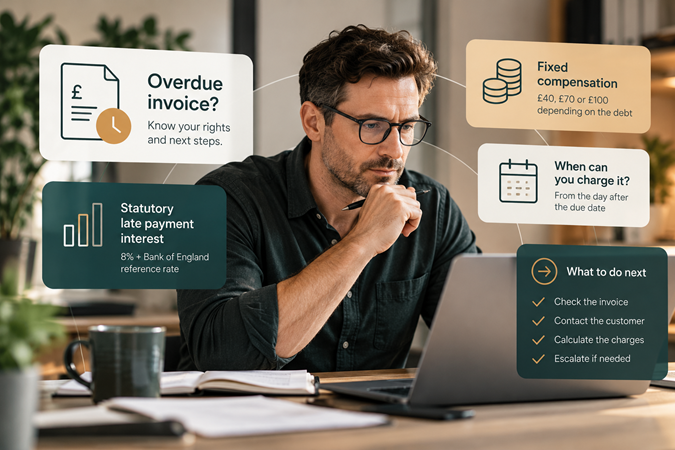
Late payment interest is something many UK businesses are legally entitled to charge, yet plenty never use it.
Some don’t know what they’re entitled to. Others worry about upsetting a customer or aren’t sure when an overdue invoice should be escalated.
I understand the hesitation. Nobody particularly wants an argument with a customer over an unpaid invoice, especially when there’s an ongoing commercial relationship to consider.
But a customer who repeatedly pays late is effectively using your business as a source of credit, often without your agreement.
Having spent more than 30 years working in credit management and debt recovery, including founding and selling Franklin James Credit Management, I’ve seen how easily overdue invoices can become accepted as part of doing business.
They shouldn’t be.
UK legislation gives businesses certain rights when commercial invoices are paid late, including statutory interest and compensation towards recovery costs.
Here’s what you can charge, how it works and, perhaps more importantly, when I’d recommend using those rights.
What is statutory late payment interest?
Statutory late payment interest is interest that businesses can claim when another business pays an invoice after the agreed payment date.
The rules are set out in the Late Payment of Commercial Debts (Interest) Act 1998, as amended.
They generally apply to qualifying business-to-business transactions for goods and services.
The statutory rate is:
8% plus the relevant Bank of England reference rate, calculated annually.
For debts becoming overdue between 1 July and 31 December 2026, the applicable statutory rate is 11.75% per annum, based on the Bank of England reference rate of 3.75%.
Importantly, the reference rate used for statutory calculations is fixed for six-month periods, based on the Bank of England rate on 31 December and 30 June.
You should always check the applicable reference rate for the period in which the debt became overdue.
One qualification matters: where your contract provides a substantial contractual remedy for late payment, that remedy may replace the statutory entitlement. Don’t assume you can automatically add statutory interest on top of a separate contractual interest clause.
You can check the rules in the GOV.UK guidance on late commercial payments.
When can you legally charge late payment interest?
If you’ve agreed payment terms with your customer, the invoice generally becomes overdue when that agreed payment deadline passes.
For example, if an invoice has valid 30-day payment terms and the customer hasn’t paid by the due date, statutory interest may begin accruing from the following day.
If you haven’t agreed a payment date, the legislation generally treats payment as late 30 days after the customer receives the invoice or the goods or services are supplied, whichever is later.
For commercial transactions:
- Private-sector businesses: Payment terms are normally expected to be no longer than 60 days, although longer periods can be expressly agreed where they aren’t grossly unfair to the supplier.
- Public authorities: Payment terms are generally limited to 30 days.
My advice: Don’t rely on statutory payment rules to compensate for poor credit control.
Make sure payment terms are clearly agreed before providing goods or services. Confirm who receives the invoices, whether purchase orders are required and when payment should be made.
Many preventable collection problems begin before an invoice is even issued.
How to calculate late payment interest in the UK
The calculation is straightforward once you’ve established the correct interest rate and the number of days overdue.
Formula:
Late payment interest = Invoice amount × annual interest rate × days overdue ÷ 365
The interest is calculated on a simple basis, rather than compounded.
Example: a £5,000 invoice that is 30 days overdue
Let’s assume the invoice became overdue during the second half of 2026 and the statutory rate of 11.75% applies.
| Calculation | Amount |
|---|---|
| Outstanding invoice, including VAT | £5,000 |
| Applicable annual interest rate | 11.75% |
| Number of days overdue | 30 |
| Interest accrued | £48.29 |
| Statutory compensation | £70 |
| Total additional amount claimable | £118.29 |
In this example, the total potential claim would be £5,118.29, including the original invoice, assuming the statutory entitlements apply.
The interest will continue to accrue while the qualifying debt remains unpaid.
For an accurate calculation, particularly on older invoices, I’d recommend using the Small Business Commissioner’s free interest calculator.
It takes account of the relevant reference rates and helps calculate the compensation that may be payable.
Can you also claim compensation for late payment?
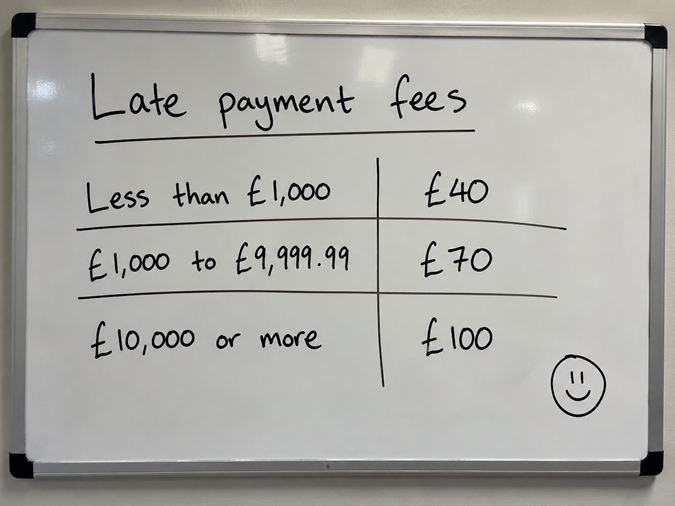
Yes. In addition to statutory interest, qualifying businesses can claim fixed compensation towards debt recovery costs.
The amount depends on the value of the debt.
| Amount of overdue debt | Fixed compensation |
|---|---|
| Less than £1,000 | £40 |
| £1,000 to £9,999.99 | £70 |
| £10,000 or more | £100 |
These amounts are set by legislation, and the entitlement applies per qualifying late payment, rather than every time you send a reminder.
You may also be entitled to additional reasonable recovery costs where those costs exceed the fixed compensation amount. The statutory entitlement is to the difference between the fixed sum and the reasonable costs incurred.
See the government guidance on claiming recovery costs.
Something I’d emphasise here: Interest and compensation are legal rights, subject to the qualifying conditions. But the fact you can charge them doesn’t mean every overdue invoice needs to begin with an interest demand.
There are circumstances where I’d use these rights as part of a firmer collection strategy. There are others where a direct conversation is more likely to get the original invoice paid promptly.
That’s where commercial judgement matters.
Should you charge late payment interest on every overdue invoice?
Personally, I wouldn’t automatically add interest to every invoice the moment it becomes overdue.
I’d first look at the customer’s payment history, the reason for the delay, the amount outstanding and what has already happened.
Consider three different situations.
Customer A: A normally reliable customer is five days late because an invoice was sent to the wrong accounts payable contact.
I’d resolve the administration issue and confirm when payment will arrive.
Customer B: A customer regularly pays 30 days beyond your agreed terms, despite reminders and previous promises.
I’d be much more inclined to raise statutory interest and compensation as part of a formal escalation.
Customer C: A significant invoice is overdue, the customer is ignoring correspondence, and there are concerns about their financial position.
I’d assess the recovery risk quickly, review the evidence and consider formal action rather than allowing further weeks to pass.
The distinction matters because the objective is to recover the money owed while making sensible decisions about risk, cost and customer relationships.
My rule would be to have a clear policy for when interest is considered, and make sure the team applies it consistently.
What if the customer disputes the invoice?
This is an important distinction.
A genuinely disputed invoice needs to be investigated before treating it as an ordinary late-payment case.
The Office of the Small Business Commissioner advises against claiming interest and compensation on invoices that are legitimately disputed.
If a customer challenges the quality of the work, the agreed amount or whether services were delivered, establish the facts and review the contractual position.
However, a customer saying “we have a query” without explaining what that query concerns shouldn’t result in an invoice being forgotten for another month.
Ask what they’re disputing, request the relevant evidence and agree a deadline for investigating it.
I’ve covered this in more detail in our article on invoice disputes and how to resolve them.
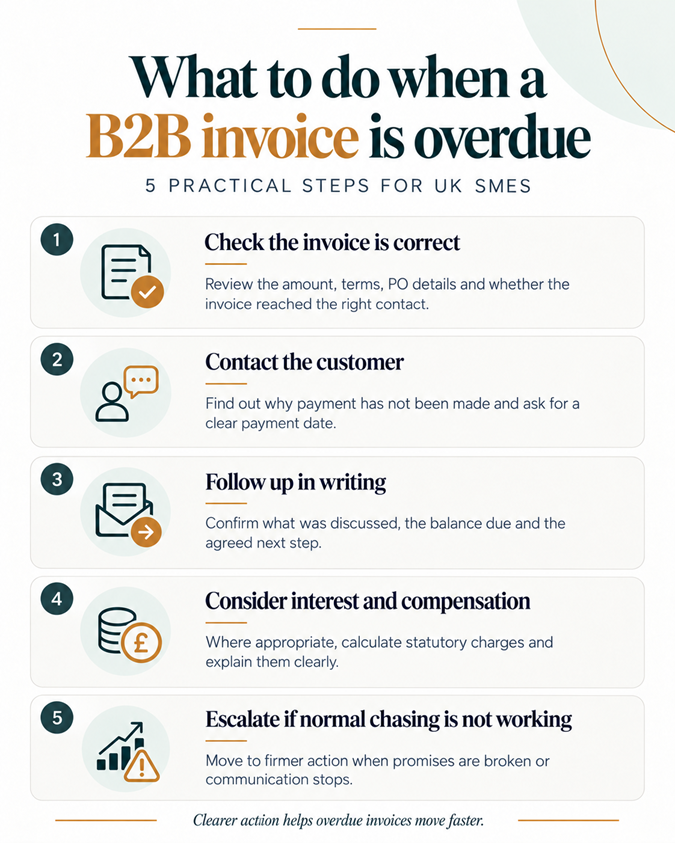
What to do when a B2B invoice is overdue
Before sending a formal demand or adding interest, I’d recommend working through the following steps.
1. Check that the invoice is correct
Confirm the amount, payment terms, purchase order information and customer details.
Check that the invoice reached the right person and whether there are any outstanding queries.
It sounds basic, but there’s little point escalating an account when your own administrative error is preventing payment.
2. Contact the customer and establish why payment hasn’t been made
I favour a telephone conversation when an invoice has become overdue and email reminders haven’t achieved anything.
Ask whether the invoice has been approved, what is preventing payment and when the funds will be transferred.
A vague response such as “we’ll get it sorted” isn’t a payment commitment.
Get an actual date.
3. Follow up in writing
Confirm what was discussed, the outstanding amount and the promised payment date.
Keep a record of correspondence and update your credit control system.
If the customer misses the commitment, you need to know exactly what was agreed and what action should follow.
4. Consider interest and compensation
Where the invoice is qualifying and remains unpaid, calculate the applicable statutory charges.
You can send a separate invoice for the interest and compensation, referencing the original debt and showing how the charges were calculated.
I’d also give the customer a clear opportunity to settle the outstanding balance.
5. Escalate when the normal chasing process isn’t working
If the customer continues ignoring payment requests or repeatedly breaks promises, consider a formal demand, external debt recovery or legal action.
The right decision depends on the amount owed, the evidence available, the customer’s financial position and the likely recovery costs.
Before issuing proceedings, check the applicable pre-action requirements and consider taking legal advice.
For eligible small businesses experiencing problems with larger customers, the Office of the Small Business Commissioner may be able to assist. It’s worth exploring that option before starting legal proceedings.
Example: how to notify a customer about late payment interest
If you’ve decided that interest and compensation are appropriate, I’d keep the communication professional and specific.
Subject: Overdue invoice [number] – outstanding payment and statutory charges
Hi [Name],
I’m following up regarding invoice [number] for £[amount], which was due for payment on [date].
Despite our previous correspondence, the balance remains outstanding.
Under the Late Payment of Commercial Debts (Interest) Act 1998, we may be entitled to claim statutory interest and fixed compensation on overdue commercial invoices.
Based on the applicable statutory provisions, the additional amount currently calculated is £[amount], comprising interest of £[amount] and compensation of £[amount].
Please confirm that the outstanding balance will be settled by [date].
If there’s an issue preventing payment, please contact me promptly so that we can establish what needs to be resolved.
Kind regards,
[Name]
I would adapt this depending on previous correspondence and whether the customer has already received a formal demand.
The important thing is to make the position clear, explain the calculation and provide a definite next step.
How to prevent late payments becoming a recurring problem
If the same customers consistently pay late, I’d look beyond individual invoices.
Review whether your business has:
- Clear payment terms agreed before work begins.
- Reliable customer credit checks and appropriate credit limits.
- Accurate invoices issued promptly.
- A consistent reminder and telephone chasing process.
- Named owners for disputes and overdue accounts.
- Agreed escalation points for broken payment promises.
I’ve seen how much stronger credit control becomes when these elements work together.
A customer should know when payment is due, your team should know when to follow up, and nobody should be deciding from scratch what to do with an invoice that’s 60 days overdue.
Frequently asked questions about late payment interest
Can I charge interest without including it in my payment terms?
Yes, statutory interest may apply automatically to qualifying commercial debts even where your contract doesn’t expressly mention it. However, an existing substantial contractual remedy for late payment can affect your entitlement.
Can I claim interest after the original invoice has been paid?
Yes. Where the statutory entitlement applies, paying the principal debt late doesn’t necessarily remove the right to claim interest and compensation for the period of delay.
Can I charge interest on the VAT element of an invoice?
The Small Business Commissioner’s statutory interest calculator uses the total invoice value, including VAT, when calculating late payment interest.
What if the customer still refuses to pay?
Review the evidence, consider the customer’s ability to pay and move to an appropriate formal recovery process where justified. Depending on the circumstances, this could involve a solicitor, debt recovery specialist or court proceedings.
My advice: know your rights, then use good judgement
When I ran FJCM, we recovered more than £25 million in overdue debt for clients.
That experience taught me that successful credit control depends on understanding what is preventing payment and knowing when a different approach is required.
Statutory late payment interest and compensation give businesses useful rights, particularly when customers repeatedly disregard agreed terms.
But I’d always start with the account itself.
Is it an administrative problem? A genuine dispute? A customer with cash flow difficulties? Or somebody who has simply become accustomed to paying whenever they choose?
The answer should determine your next move.
The longer an overdue invoice sits without a clear action, the greater the risk of it becoming difficult to recover.
If you’ve got outstanding invoices and aren’t sure which customers to chase, what to say or when to escalate, our Aged debt action plan & templates provides a practical 30-day collection plan.
For a single overdue invoice, start with our free overdue invoice checklist. It covers what to check, what to send, when to call and when to escalate.