

How to reduce aged debt starts with understanding where the money is concentrated.
When we review an aged debtor ledger, the quickest opportunity is often obvious once the accounts are sorted by value.
A relatively small number of customers can account for a large proportion of the total debt. That is why we often start with a Pareto-style analysis, ranking debtors from highest to lowest balance and calculating the cumulative percentage of debt they represent.
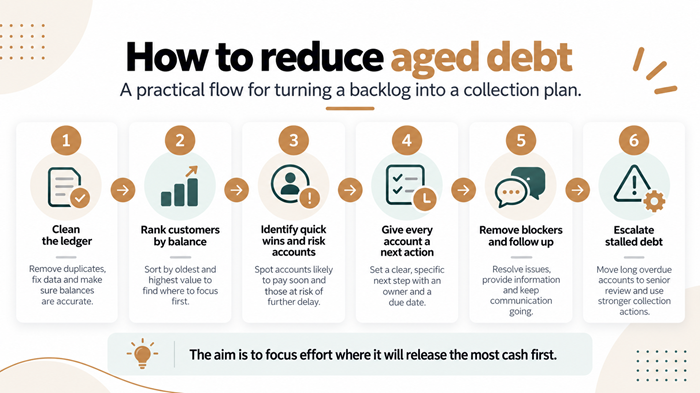
The aim is to identify the accounts where focused action can release the most cash first.
From there, you can separate straightforward collections from disputes, broken promises, risk accounts and debt that now needs escalation.
Aged debt needs a prioritised plan.
What is aged debt?
Aged debt is money customers owe your business that remains unpaid after the agreed payment date and is tracked according to how long it has been outstanding.
An aged debtor report commonly groups invoices into periods such as:
- current
- 1 to 30 days overdue
- 31 to 60 days overdue
- 61 to 90 days overdue
- 90+ days overdue
Age is useful because older debt generally needs closer attention.
Value matters just as much when the objective is reducing the balance quickly.
A £40,000 balance that is 45 days overdue can have far more impact on cash flow than twenty £300 invoices sitting at 90 days.
That is why the first question we usually ask is: Where is most of the money?
How to reduce aged debt in 7 practical steps
1. Start with a Pareto analysis of the debtor ledger
Sort the aged debtor report by total outstanding balance per customer, from highest to lowest.
Then calculate how much of the overall debt is concentrated in the top accounts.
The Pareto principle is often described as the 80/20 rule: a relatively small proportion of inputs can account for a large proportion of the result.
In credit control, the exact numbers vary, but the principle is useful.
You may find that:
- the top 10 customers account for most of the overdue balance
- 20% of debtors account for the majority of the money owed
- one or two large accounts are driving a significant part of the aged-debt position
That immediately tells you where to focus first.
If the ledger contains £250,000 of aged debt and £150,000 sits across six customers, those six accounts deserve immediate attention.
This is one of the fastest ways to create movement because it concentrates effort where the cash impact is greatest.
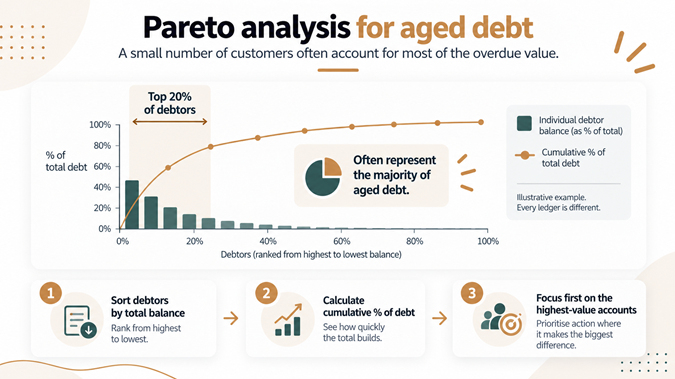
Build a cumulative debt view
A simple Pareto analysis can include:
- Customer
- Total outstanding
- Oldest invoice
- Percentage of total aged debt
- Cumulative percentage
- Current status
Next action
Once the accounts are sorted by value, you can see very quickly where the debt is concentrated. That becomes the starting point for the collection plan.
2. Clean the high-value accounts before chasing them
Before contacting the biggest debtors, check that the balances are correct.
Look for:
- payments received but not allocated
- credit notes waiting to be processed
- duplicate invoices
- incorrect balances
- unapplied cash
- old disputes
- invoices raised against the wrong entity
- payment plans already in place
There is little value in prioritising a £50,000 balance if £20,000 has already been paid and the ledger simply hasn’t been updated.
Clean the figures first.
Then confirm the genuine exposure.
3. Prioritise by value, age, risk and collectability
Once the largest balances are clear, add context.
I normally look at four things:
- Value: How much cash is tied up?
- Age: How long has it been overdue?
- Risk: Is payment behaviour deteriorating?
- Collectability: Is there a clear route to getting paid?
This helps distinguish between high-value debt that can move quickly and high-value debt that needs a different approach.
For example:
A £30,000 invoice at 35 days overdue with no dispute and a known finance contact may be a strong collection opportunity.
A £25,000 invoice at 70 days overdue with a contractual dispute may need internal resolution first.
A £15,000 balance with three broken payment promises may need escalation.
The value tells you where the impact sits. The context tells you what action to take.
4. Segment the ledger into practical collection groups
Once the highest-value accounts have been reviewed, I would group the debt by collection type.
High-value quick wins
These are the accounts you want early in the process.
Typical signs include:
- invoice accepted
- no dispute
- customer responsive
- clear payment contact
- historically reliable payer
- payment date already discussed
These accounts can often produce a large reduction quickly.
High-value risk accounts
These need more scrutiny.
Look for:
- repeated late payment
- broken promises
- multiple overdue invoices
- increasing exposure
- credit limits exceeded
- slowing communication
- signs of financial pressure
These accounts deserve active management because the financial exposure is material.
Disputed or blocked debt
Something specific is preventing payment.
Typical causes include:
- missing purchase order
- pricing query
- service complaint
- incorrect invoice
- credit note required
- delivery issue
- missing documentation
Each blocker needs an owner and a deadline.
Low-value aged debt
Smaller balances still matter, especially in aggregate.
They can usually be handled through a more standardised chasing sequence once the high-value accounts have been dealt with.
This is where templates and automation can improve efficiency.
5. Give every overdue account a next action
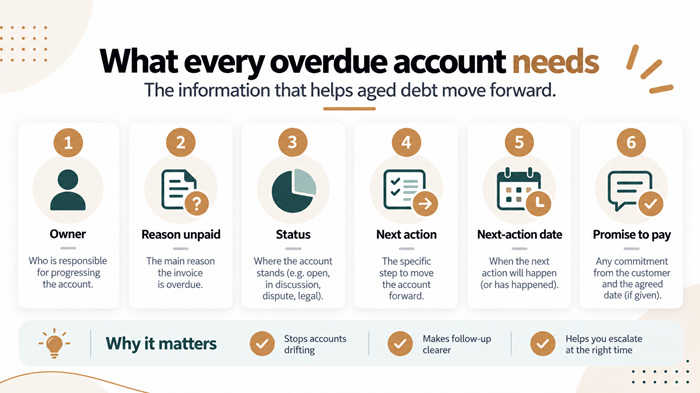
Every aged invoice should have:
- an owner
- a status
- a next action
- a next-action date
For example:
£18,500 outstanding. Invoice approved. Customer promised payment on 25 September. Check receipt on 25 September and call finance director that afternoon if unpaid.
That gives the account momentum.
A note saying “chased customer” gives very little useful information.
For high-value accounts in particular, the next action should be explicit.
Record promises to pay properly
Promises to pay are useful because they create a specific commitment.
Record:
- who made the promise
- the amount
- the payment date
- any conditions
- the next action if payment doesn’t arrive
Then follow it up on the agreed date.
Repeated broken promises should influence the escalation decision.
6. Remove blockers and escalate stalled accounts
Some aged debt needs action from your own business.
That may involve:
- issuing a credit note
- correcting an invoice
- providing proof of delivery
- locating a purchase order
- answering a service query
- confirming contractual information
Give each issue an internal owner.
Then give it a deadline.
High-value blocked invoices should be treated as commercial priorities.
For accounts where normal chasing has stopped producing progress, move into escalation.
Possible actions include:
- senior management contact
- suspension of further credit
- payment-plan discussions
- final demand
- statutory interest and recovery costs
- external debt collection
- legal action
For qualifying B2B debts, current UK rules allow businesses to claim statutory interest at 8% plus the Bank of England base rate, where a different contractual rate does not apply. Fixed recovery costs may also be available depending on the debt value. (gov.uk)
7. Track the reduction and repeat the Pareto analysis
Once collection activity starts, rerun the analysis regularly because the shape of the ledger will change.
As the largest balances are collected, different accounts move into the priority group.
I would track:
- total aged debt
- cash collected
- value held in the top 10 accounts
- percentage of debt concentrated in the top 20% of debtors
- 90+ day debt
- disputes resolved
- payment promises kept
- accounts escalated
This gives you a clearer picture of whether the ledger is actually improving and It also helps prevent the same accounts from remaining at the top of the report month after month.
What I would do with an aged debt backlog
If I was handed an aged debtor report tomorrow, I would start by sorting it by customer balance from highest to lowest.
Then I would work out how much of the total debt sits in the top group.
That usually shows very quickly where the biggest opportunity is.
I would then:
- credit check the customers and check details on Companies House
- identify any disputes or blockers
- contact the highest-value collectable accounts first (email and call)
- record payment commitments
- escalate high-value accounts where normal chasing has stalled
- work through the remaining ledger by priority
- rerun the analysis as payments come in
This is how aged debt can fall quickly.
The objective is to focus effort where it will have the biggest cash impact.
Use the aged debtor report as a management tool
An aged debtor report should help you decide what to do.
The most useful version shows:
- where the money is concentrated
- which accounts present the greatest risk
- which invoices are blocked
- which customers have promised payment
- where action has stalled
- what should happen next
That gives the business control over the backlog.
It also creates better information for future credit decisions.
If one customer repeatedly appears near the top of the aged-debt list, that should influence future terms and credit limits.
Reduce aged debt with a clear action plan
Aged debt falls faster when the business knows where to focus.
Start with the biggest balances.
Use Pareto analysis to identify where the money is concentrated.
Then separate quick wins, disputes, risk accounts and stalled debt.
Give every account an owner and a next action.
Collect Wise’s Aged Debt Action Plan follows this approach.
We review the aged debtor ledger, identify where the debt is concentrated, prioritise the accounts with the greatest opportunity or risk and build a practical 30-day collection plan.
You also receive the templates needed to carry the plan out in-house, including chasing communications, dispute responses, payment-plan wording, escalation steps and Letter Before Action guidance.