
Reduce late payments by looking at the whole payment process, starting before the invoice is sent.
Businesses often focus on chasing once an invoice becomes overdue. By that point, the cause of the delay may already be several weeks old.
Payment terms may have been unclear. The purchase order may be missing. The invoice may have gone to the wrong person. A query may be sitting unresolved. Nobody may have checked whether the invoice was approved for payment.
This matters because late payment remains a sizeable problem for UK businesses. Government-backed research estimates that more than 1.5 million businesses are affected by late payments, while around £26 billion can be sitting in overdue invoices at any given time.
The strongest credit control processes deal with potential payment problems early.
How to reduce late payments in 10 practical steps
There is rarely one single reason customers pay late.
Reducing late payment means removing the avoidable delays throughout the customer journey and responding quickly when something starts to drift.
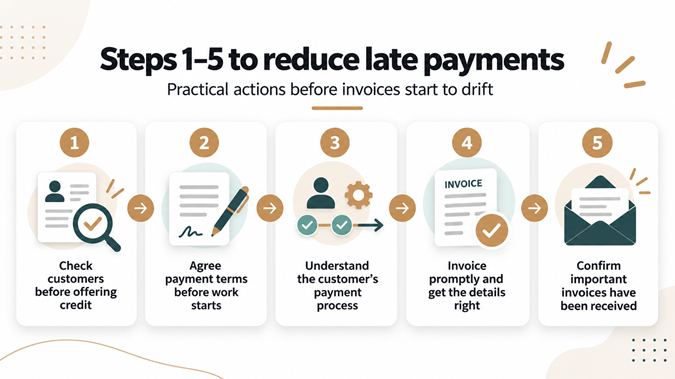
1. Check customers before offering credit
Credit is a commercial decision.
Before allowing a new customer to buy now and pay later, understand who you’re extending credit to.
Depending on the size of the order and level of risk, that may mean checking:
- Companies House information
- commercial credit reports
- previous payment history
- existing exposure
- requested credit limits
- trading references
- financial information where appropriate
You don’t need the same level of due diligence for every customer.
The level of checking should reflect the amount of money you’re prepared to have outstanding.
This is particularly important when a new customer places an unusually large order.
A large sale looks attractive on the sales report. Its value to the business depends on collecting the money.
2. Agree payment terms before the work starts
Payment terms need to be part of the commercial conversation.
Agree:
- how much the customer will pay
- when payment is due
- how invoices should be submitted
- whether a purchase order is required
- who approves payment
- which payment method will be used
- what happens if payment becomes overdue
Avoid vague wording where possible.
A specific due date is easier for both parties to understand and manage.
For larger projects, you might also consider deposits, staged payments or milestone billing rather than allowing the entire value of the work to become outstanding at once.
The right terms depend on the customer, project and level of risk.
3. Understand the customer’s payment process
One of the simplest questions businesses fail to ask is:
What do you need from us to pay this invoice on time?
The person buying from you may have very little involvement in paying you.
Larger organisations may require a purchase order, supplier registration, portal submission, departmental approval or invoices sent to a specific accounts-payable address.
Find this out at the beginning.
The Office of the Small Business Commissioner specifically recommends identifying the correct invoice recipient, confirming the payment schedule and obtaining required purchase order information early.
A perfectly accurate invoice sent to the wrong place can still be paid late.
Obtaining this relevant information should form part of your accounts receivable management process.
4. Invoice promptly and get the details right
Send the invoice as soon as the agreed trigger for billing has been reached.
Waiting until the end of the month because that’s when somebody normally does the invoicing delays the whole payment cycle.
Then check the invoice.
Does it contain:
- the correct legal entity? (company name, sole trader name) etc
- the correct invoice address?
- an invoice number?
- the purchase order number?
- a clear description of the work?
- the agreed amount?
- VAT information where applicable?
- the correct due date?
- the agreed payment terms?
- accurate bank details?
The Small Business Commissioner advises businesses to submit invoices promptly and make sure the information customers need to process payment is included.
Every correction adds another opportunity for the payment date to move.
5. Confirm important invoices have been received
For new customers, high-value invoices or customers with a history of paying slowly, confirmation of receipt can be useful.
You aren’t chasing an overdue invoice at this stage.
You’re establishing that it has reached the right place and entered the customer’s payment process.
Ask whether:
- the invoice has been received
- the information is correct
- it has been approved
- anything further is required
- payment is scheduled
That short conversation can expose a missing PO or disputed detail before the due date arrives. At this point you can always ask for the payment run date too.
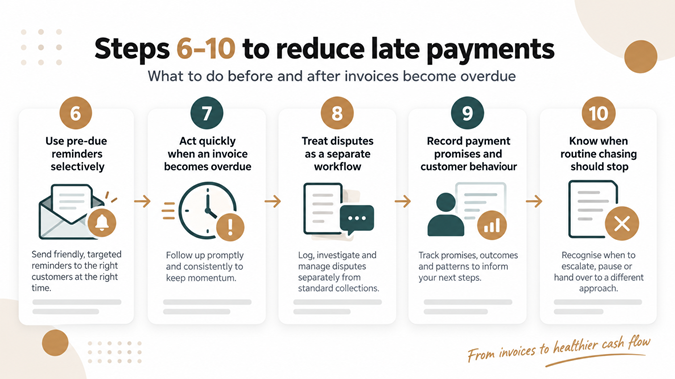
6. Use pre-due reminders selectively
A reminder shortly before payment is due can work well for the right accounts.
The wording doesn’t need to be aggressive.
You can confirm the invoice number, value and due date, then ask whether everything is in place for payment.
Use judgement here.
A reliable customer who has paid correctly for ten years probably doesn’t need unnecessary chasing.
A new customer, a high-value account or somebody whose payment history is inconsistent deserves closer attention.
Credit control works better when activity reflects risk and payment behaviour.
7. Act quickly when an invoice becomes overdue
Once the payment date passes, follow the agreed process.
The first action shouldn’t depend on somebody noticing the invoice three weeks later.
Your team should know:
- when the first reminder is sent
- when to telephone
- who should be contacted
- how responses are recorded
- how promises to pay are followed up
- when the account moves to the next stage
Speed matters.
If a customer hasn’t paid because something is wrong, you want to know.
If they have simply missed the payment, early contact can move it back up their priority list.
If their financial position is deteriorating, waiting another month rarely improves your position.
8. Treat disputes as a separate workflow
A disputed invoice needs action.
Repeatedly sending payment reminders while the customer is waiting for somebody in your business to answer a query achieves very little.
Record:
- what is being disputed
- when the dispute was raised
- who owns the issue internally
- what information is required
- the target resolution date
- what happens once it is resolved
Then monitor it.
One of the easiest ways for debt to age is allowing an invoice dispute to disappear between finance, sales, operations and the customer.
Give the dispute an owner and a next action.
9. Record payment promises and customer behaviour
When somebody says they’ll pay on Friday, record Friday.
If the payment arrives, you have useful payment-history information.
If it doesn’t, follow up immediately.
Repeated broken promises should influence how you manage the account.
The same applies to customers who consistently:
- dispute invoices at the last moment
- ignore reminders
- exceed agreed terms
- ask for extensions
- require repeated escalation
- make part payments without agreement
Payment behaviour tells you something about credit risk.
Use that information when deciding future terms, credit limits and how closely the account needs monitoring.
10. Know when routine chasing should stop
Every credit-control process needs escalation points.
There comes a stage where sending another version of the same reminder stops being productive.
Depending on the debt and customer relationship, the next step might include:
- a senior-level conversation
- pausing further credit
- agreeing a formal payment plan
- sending a final demand
- applying statutory interest and recovery costs where appropriate
- involving the Small Business Commissioner where eligible
- moving towards formal debt recovery
The decision should reflect the value of the debt, the customer’s circumstances, previous payment behaviour, the commercial relationship and the likelihood of recovery.
Your team needs to know who can make that decision.

Should you offer early-payment discounts?
Sometimes.
I wouldn’t use discounts as the standard solution to late payment.
Every discount reduces the margin you’ve already earned.
If a customer owes £10,000 under agreed 30-day terms, routinely giving away 2% to persuade them to pay can become an expensive way of correcting a payment problem.
There are situations where an early-payment discount makes commercial sense.
For example, accelerating a substantial payment may improve working capital enough to justify the cost, or the discount may form part of a deliberately negotiated commercial arrangement.
Run the numbers first.
Then decide whether you’re buying worthwhile payment certainty.
Can automation help reduce late payments?
Yes, particularly with consistency.
Modern accounting and credit-control systems can help businesses:
- issue invoices promptly
- schedule reminders
- track due dates
- flag overdue accounts
- monitor promises to pay
- provide online payment options
- prioritise accounts
- identify changes in payment behaviour
AI tools are also beginning to support tasks such as prioritising payment-related emails, drafting routine reminders and identifying accounts that need attention. The Small Business Commissioner now provides guidance specifically on using AI to support late-payment processes.
Set clear rules around the technology.
A disputed £50,000 invoice needs different handling from an automatically generated £150 subscription invoice.
Customer history, risk, value and context still matter.
Measure whether late payment is improving
If you want to reduce late payments, measure what is happening. Try our free calculator here
Useful indicators include:
- percentage of invoices paid on time
- value of overdue debt
- ageing by 30, 60, 90 and 120+ days
- Days Sales Outstanding
- value tied up in disputes
- number of broken payment promises
- average time taken to resolve disputes
- customers repeatedly exceeding agreed terms
Then look for patterns.
Perhaps one customer accounts for a large proportion of overdue debt.
Perhaps disputes are concentrated around one part of the business.
Perhaps invoices are consistently being issued several days after work is completed.
Perhaps customers on 30-day terms routinely pay in 45.
Those findings tell you where the process needs attention.
A 2026 update on UK late-payment rules
The UK’s late-payment framework is currently changing.
The Commercial Payments (Late Payments) Bill is progressing through Parliament. Proposed measures include a 60-day maximum payment term in many business-to-business transactions, mandatory late-payment interest and stronger enforcement powers for the Small Business Commissioner.
As of September 2026, the Bill is still progressing through Parliament and the details can change before becoming law.
Businesses should continue following the rules currently in force and check official guidance as the legislation progresses.
The current statutory framework allows businesses to claim interest and debt-recovery costs on qualifying late commercial payments.
What I would check first if late payment keeps happening
If I was looking at a business with recurring late payment, I wouldn’t start by rewriting its reminder emails.
I’d follow an invoice from beginning to end.
How was the customer set up?
What terms were agreed?
Was the purchase-order process understood?
When was the invoice raised?
Where was it sent?
Was receipt confirmed?
What happened before the due date?
What happened on the first day overdue?
Were calls made?
Were promises recorded?
How quickly were disputes resolved?
When was the account escalated?
That usually tells you much more than looking at an aged debtor report in isolation.
The aged debt is the outcome.
The process shows you where payment is being allowed to drift.
Reduce late payments by fixing the recurring causes
Customers won’t always pay exactly when you want them to.
Businesses can still control a large part of the payment process.
Clear terms, accurate invoices, good customer information, early contact, disciplined follow-up, quick dispute resolution and defined escalation all reduce the opportunities for an invoice to drift.
If late payment keeps repeating across several customers, it’s worth reviewing the process behind it.
Collect Wise’s Credit Control Review & Setup examines the full payment journey, including customer onboarding, payment terms, invoicing, chasing, disputes and escalation.
We identify where control is being lost and put practical processes in place so your team knows what should happen, who owns it and when an account needs further action.