

A good credit control strategy answers a fairly simple question: how are you going to make sure customers pay you when they agreed to?
The answer affects far more than the aged debtor report.
Payment terms, invoicing, reminders, customer conversations, disputes and escalation all influence how quickly money reaches your bank. They also shape the experience your customer has when something goes wrong.
And late payment remains a sizeable problem. Government-backed research found that around 1.5 million UK businesses, 28% of businesses, are affected by late payments each year. Businesses are estimated to be owed £26 billion in late payments at any given time, while affected businesses spend an average of 86 hours a year chasing money they are already owed.
Perhaps most interestingly, 15% of businesses surveyed said they had avoided doing business with particular customers because of their payment behaviour.
I’ve worked in credit management for more than 20 years, including building and selling a credit management business that recovered more than £25 million for clients. The businesses with the best collections tend to have the same things in common: customers know what is expected, somebody owns the process and overdue accounts are dealt with consistently.
They don’t leave the difficult conversations until an invoice is 60 days late.

What is a credit control strategy?
A credit control strategy sets out how your business will manage customer credit and payment from the beginning of the relationship through to collection and, where necessary, escalation.
It should cover:
- who you are prepared to offer credit to and on what terms
- how payment terms are communicated and agreed
- when and how invoices are issued
- what happens before and after an invoice becomes due
- how disputes and queries are handled
- how payment promises and payment plans are recorded
- when an overdue account moves to firmer action
- who owns each stage
- which measures tell you whether the strategy is working
For an SME, this doesn’t need to become a 40-page policy gathering dust in SharePoint.
It needs to be clear enough that two different people dealing with the same customer would take roughly the same action.
Consistency matters.
A good credit control strategy reduces surprises
A surprising amount of friction around credit control is created by uncertainty.
The salesperson says one thing. The invoice says another. The customer thinks they have 60 days. Finance thinks they agreed 30. Nobody has checked who needs to approve the invoice. The first payment reminder arrives two weeks after the invoice became overdue.
Then somebody has to make an awkward phone call.
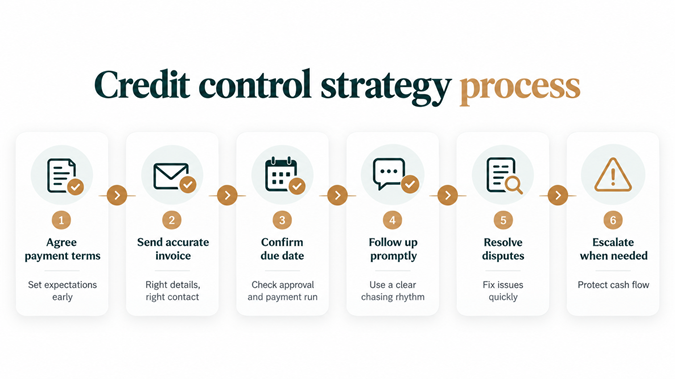
A stronger approach starts before the invoice exists.
Payment terms should be agreed during onboarding. Your customer should know when invoices will arrive, how long they have to pay, what information you need from them and who to contact if there’s a query.
You should know the customer’s accounts payable process too.
Do they require a purchase order? Is there a supplier portal? Does an invoice need to quote a particular reference? Who approves it? When are payment runs made?
These details look administrative until one missing PO number delays a £20,000 invoice for another month.
Good credit control removes those avoidable delays early.
Make paying you straightforward
Sometimes a late invoice tells you more about your own process than the customer’s.
Invoices sent late, incorrect company details, missing purchase orders, unclear bank details and invoices going to the wrong person all create friction.
Before chasing a customer, check that you have done your part properly.
That sounds obvious. In practice, I’ve seen businesses spend weeks chasing an invoice before discovering that it was never received by the person responsible for approving it.
The strongest credit control techniques often start with fairly mundane basics done properly.
Get the invoice out promptly. Check the information. Confirm the correct contact. Make the due date obvious. Give the customer a straightforward way to raise a query.
Then there is far less room for confusion later.
Use a predictable chasing rhythm
One of the easiest ways to weaken credit control is to chase according to mood.
A customer receives nothing for three weeks, then three increasingly irritated emails arrive within five days because somebody has finally looked at the debtor report.
That feels inconsistent because it is inconsistent.
Decide when contact happens and what each stage is trying to achieve.
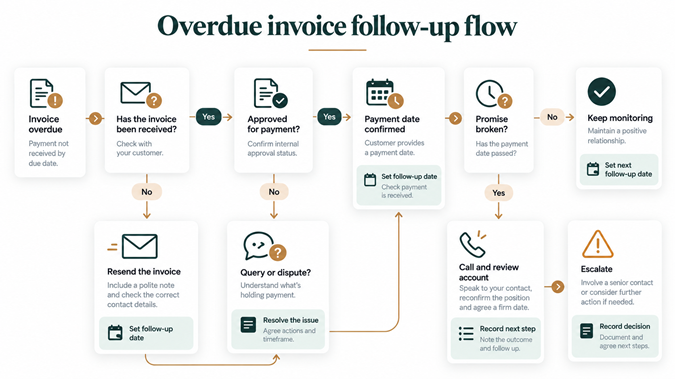
An early reminder might simply confirm that the invoice has been received and is scheduled for payment. Once the invoice is overdue, the conversation becomes more specific. Further delay should trigger a call, a firmer follow-up or escalation according to the circumstances.
Customers quickly learn how seriously a supplier treats its payment terms.
If every deadline passes without consequence, that becomes useful information too.
Ask better questions when payment is late
One of the most useful skills in credit control is knowing how to move a conversation forwards.
“Just checking when you might be able to pay this” gives the customer plenty of room to give you a vague answer.
A better conversation deals in facts.
“Invoice 1248 for £4,280 was due on 30 September. Can you confirm whether it has been approved and the date it is scheduled for payment?”
If the answer is Friday, confirm Friday.
If they can’t give you a date, find out what’s stopping them.
If there’s a query, identify exactly what needs resolving and who owns it.
If they need to speak to somebody else, agree when you will follow up.
The objective is a specific next step.
I’ve seen far too many debtor notes containing comments such as “customer says they’ll look into it” or “accounts are going to speak to the director”.
Those aren’t payment commitments. They’re conversations waiting to happen again.
Customer payment behaviour tells you something
Your customer payment behaviour should influence how you manage the account.
A customer who has paid five consecutive invoices two weeks late is showing you a pattern.
A large, well-known customer can still be a poor payer. A small customer can be excellent.
Treat the evidence seriously.
Look at how long customers usually take to pay, how often promises are broken, whether disputes repeatedly appear at the last minute and how much time your team spends chasing them.
You can then decide whether the current credit limit and terms still make sense.
You start making decisions based on payment behaviour instead of assuming every customer should continue receiving the same level of credit indefinitely.
Government statistics published in July 2026 show that even among large UK businesses, 15% of invoices were paid late during 2025. The average time taken by large businesses to pay suppliers was 32 days. Payment performance has improved since reporting began in 2018, although late payment clearly hasn’t disappeared.
Deal with disputes quickly
Disputes are one of the biggest places for overdue invoices to disappear.
A customer says the invoice is wrong. Finance forwards the email to operations. Operations asks somebody else. Nobody owns the next action and suddenly another three weeks have passed.
A good credit control strategy gives disputes their own process.
Record what the customer is disputing, the amount involved, who needs to resolve it and the deadline for doing so.
And separate the disputed element from the undisputed amount where appropriate.
A £500 query shouldn’t automatically leave a £10,000 invoice untouched for a month.
Repeated disputes also deserve investigation. They may reveal an invoicing problem, poor order information, communication issues or a customer using queries to delay payment.
Either way, that information is valuable.
Know when email has stopped working
Email is useful for confirming information and creating a written record.
It is also very easy to ignore.
If you’ve sent multiple reminders without getting anywhere, another version of the same email is unlikely to produce a sudden breakthrough.
Pick up the phone.
A short conversation can establish whether the invoice is approved, whether there is a problem, who has authority to release payment and when money will arrive.
This is one of the areas where confidence matters. People responsible for credit control sometimes avoid calling because they don’t want to sound confrontational.
Professional credit control shouldn’t sound confrontational.
You know what is owed, when it was due and what has happened so far. Stick to those facts. Ask clear questions. Listen to the answer. Agree the next action.
Good credit control communication is calm, specific and difficult to misunderstand.
Escalation protects the process
Escalation shouldn’t arrive as a surprise.
Customers should be able to see that the account is moving through a clear process.
Reminder. Call. Follow-up. Final request. Payment plan where appropriate. Formal recovery when necessary.
The circumstances will determine the right route, particularly where there is a legitimate dispute or financial difficulty.
What matters is that your business has decided what happens when the previous step hasn’t worked.
Leaving old invoices untouched because you value the customer creates its own commercial risk.
A valuable customer who consistently pays late is still using your cash.
There comes a point where protecting the wider business requires a firmer decision about credit limits, future work, payment upfront or formal recovery.
Credit control and sales need to talk to each other
Some of the worst payment problems I’ve seen start with good intentions during the sales process.
A salesperson wants the deal signed. Payment terms get extended casually. A customer asks for something outside the normal process. Nobody tells finance.
Thirty or sixty days later, credit control inherits the problem.
Sales should understand the company’s credit terms and know which concessions require approval. Credit control should also feed useful information back.
If a customer repeatedly breaches terms, sales and account management need to know.
If a customer is experiencing a temporary issue and communicating properly, that context matters too.
Credit decisions affect commercial relationships, so the people managing those relationships need the same information.
Measure whether your credit control strategy is working
Looking at the bank balance isn’t enough.
Monitor your Days Sales Outstanding, the amount of debt sitting in different ageing brackets, the percentage of invoices being paid within terms, broken payment promises, recurring disputes and how quickly queries are resolved.
Look for trends rather than isolated incidents.
If DSO starts increasing, find out why.
If one customer is repeatedly moving into 60-day debt, review the account.
If most late invoices have the same internal problem attached to them, fix the problem upstream.
Credit control data should help you make decisions.
Our free DSO calculator can help you establish how long it currently takes your business to collect payment after making a sale.
Firm. Fair. Predictable.
Those are the three words I’d use to describe effective credit control.
Firm means you are clear about what is owed, when payment is due and what needs to happen next.
Fair means genuine disputes are investigated properly, financial difficulties are considered sensibly and customers are treated professionally.
Predictable means your business follows a consistent process, keeps its promises and escalates accounts when agreed actions aren’t met.
That combination tends to produce far better conversations.
Your customers know where they stand. Your team knows what to do. And late payment is less likely to become a recurring monthly argument.
Frequently asked questions about credit control strategy
Can strong credit control damage customer relationships?
Poor communication, inconsistent chasing and unexpected escalation can create unnecessary friction with customers. A clear process gives customers advance notice of payment expectations and provides a structured way to resolve problems when they arise.
When should you chase an overdue invoice?
Your chasing schedule should be agreed as part of your credit control process. Many businesses benefit from confirming invoice receipt before the due date, following up promptly once payment becomes overdue and increasing the level of contact where commitments aren’t met.
Should credit control be handled by email or phone?
Both have a role. Email creates a useful written record and works well for reminders and confirmation. Telephone conversations are particularly valuable when an invoice remains unpaid, the reason is unclear or you need a specific payment commitment.
How can a business improve collections?
Start by reviewing the full payment journey: customer onboarding, credit terms, invoicing, reminders, telephone contact, dispute handling and escalation. Patterns in aged debt often reveal where the process needs attention.
If your credit control keeps becoming a chasing exercise
Repeated late payment usually deserves a wider look at the process.
Collect Wise’s Credit Control Review & Setup examines payment terms, onboarding, invoicing, chasing, disputes and escalation, then puts a practical process in place for your team to manage.
If your process is sound but your team needs more confidence handling customers, excuses, payment promises and difficult conversations, our Credit Control Training focuses on the practical collection skills people use every day.
And if you already have a ledger full of overdue accounts and aren’t sure where to start, download the Overdue Invoice Checklist for a practical guide to checking, chasing and escalating overdue invoices.