

A credit control process is the repeatable system a business uses to decide who receives credit, issue invoices, monitor payment, follow up outstanding accounts and escalate overdue debt.
For UK SMEs, the aim is simple: make sure every invoice has an owner, a status and a clear next action.
That structure matters because late payment often develops gradually. An invoice may have the wrong purchase order, a dispute may sit unresolved, somebody may promise payment without it being recorded, or chasing may stop for several weeks.
A good process catches those issues early and gives the team clear rules for what happens next.
What should a credit control process include?
A practical credit control process should cover the entire payment journey:
- who can receive credit
- what terms and credit limits apply
- what information is required before invoicing
- when invoices are raised
- how outstanding accounts are monitored
- how reminders, calls and payment promises are managed
- how disputes are handled
- when an account is escalated
The Office of the Small Business Commissioner recommends many of the same foundations, including written payment terms, prompt invoicing, credit checks where appropriate and immediate contact once an invoice becomes overdue.
The important part is turning those individual activities into one connected process.
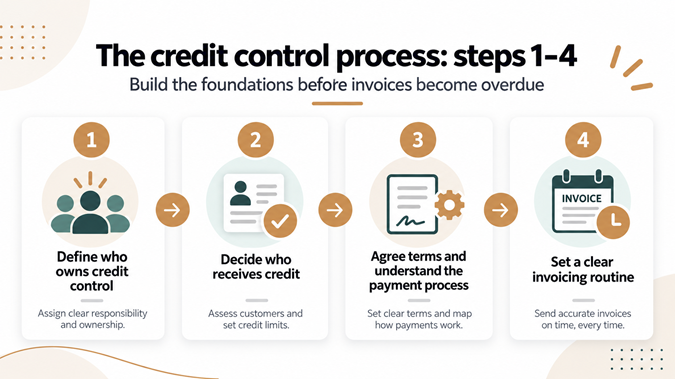
Step 1: define who owns credit control
Start with ownership.
Someone needs overall responsibility for the debtor ledger and payment process.
In a smaller business, that might be:
- the owner
- finance manager
- accounts assistant
- bookkeeper
- office manager
- credit controller
Other people will still need to contribute. For example, sales may need to provide customer information, operations may need to resolve disputes and Directors may need to approve credit limits or escalation.
The process should make those responsibilities explicit.
For each stage, you should decide:
- Who owns it?
- What are they expected to do?
- When should they do it?
- Who takes over if the account becomes more serious?
A written process removes unnecessary decisions from the day-to-day work.
Step 2: decide who receives credit and how much
Offering payment terms means allowing a customer to use your money for a period of time. So you should set some rules around that.
For new customers, you may want to consider:
- credit checks
- Companies House information
- expected monthly spend
- previous trading history
- references
- credit limits
- deposits
- staged payments
- shorter initial payment terms
The level of checking should reflect the amount of exposure.
A customer asking for £500 of credit presents a different commercial risk from a new customer wanting £50,000 outstanding at once.
Credit limits should also be reviewed.
A customer who regularly pays late, exceeds their limit or breaks payment promises may need different terms in future. Credit control and sales will need to work together on this!
Credit control works best when customer payment behaviour feeds back into future commercial decisions.
Step 3: agree terms and understand the customer’s payment process
Before work begins, ideally during the “taking the order” stage, confirm:
- payment terms
- invoice recipient
- billing address
- purchase order requirements
- invoice submission method
- relevant payment portal
- payment run dates
- approval process
- contractual late-payment provisions
This is where sales and finance need to join up because the salesperson may know who agreed the work, but Finance needs to know who can actually authorise the payment.
For larger organisations, those can be completely different people, completely separate departments in entirely different locations.
One useful question is:
“What does your finance team need from us for this invoice to be approved and paid on time?”
That answer can prevent weeks of unnecessary chasing later and reduce impact on cash-flow.
Step 4: set a clear invoicing routine
Decide exactly when invoices should be raised.
For example:
- on delivery
- when a milestone is completed
- monthly
- immediately after work is approved
- on a specified contractual date
Then decide who checks the information.
A good invoice should include the correct customer details, invoice number, purchase order where required, description of the goods or services, payment terms, due date and payment information.
The Small Business Commissioner specifically advises businesses to invoice as soon as possible after work is completed and include all information required to make the invoice payable. Some of the biggest company challenges we come across in credit control is because the company didn’t invoice fast enough.
Delaying invoicing delays the payment cycle from the start.
This is also a core part of effective accounts receivable management, because outstanding invoices need active ownership rather than simply appearing on a report.
Step 5: create a consistent monitoring and chasing schedule
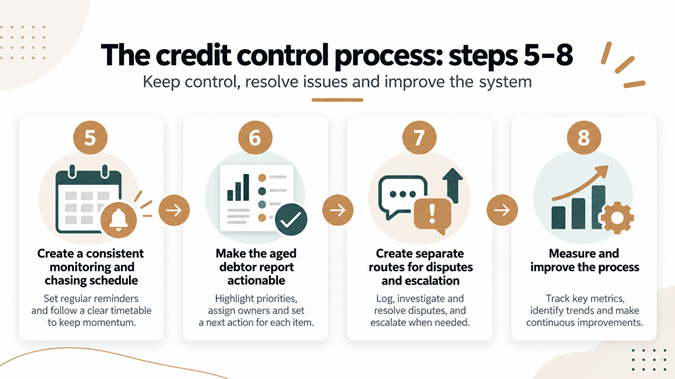
Your credit control process should say what happens before and after the due date. If recurring late payment is already a problem, there are several practical ways to reduce late payments across the wider payment process.
A simple example might look like:
7 days before due: review larger or higher-risk invoices.
3 days before due: confirmation or reminder where appropriate.
Due date: check whether payment has arrived or is scheduled.
1-3 days overdue: first follow-up.
7 days overdue: further email or telephone contact.
14 days overdue: firmer contact and account review.
30 days overdue: escalation decision.
Those timings are examples. Your own process should reflect your customers, invoice values, sectors and risk.
What matters is consistency.
Two customers in the same circumstances shouldn’t receive completely different treatment simply because different people happen to be managing them.
Step 6: make the aged debtor report actionable
An aged debtor report shows you what is outstanding. Your credit control process needs to record what happens next.
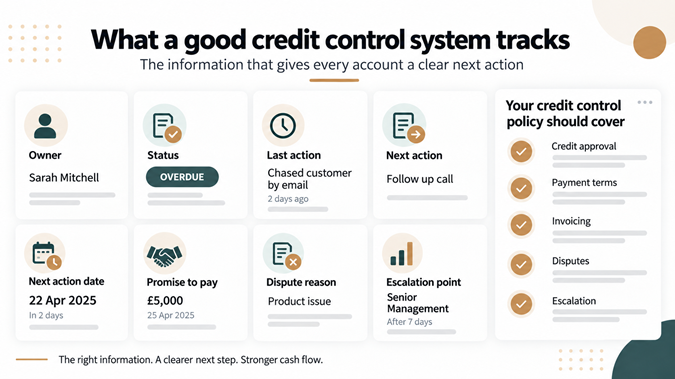
For every unpaid account, I would want to see information such as:
Status: overdue, disputed, promised, payment plan, escalation.
Owner: who currently needs to act.
Last action: what happened most recently.
Next action: email, call, internal query, escalation.
Next action date: when it needs to happen.
Promise to pay: amount and date where applicable.
Dispute: reason and internal owner.
This is one of the biggest differences between looking at debt and managing it.
An invoice showing as £12,000 and 47 days overdue tells you the age and value.
Knowing the customer promised £12,000 for Friday, who confirmed it and what happens if the payment doesn’t arrive tells you how the account is being controlled.
Record promises to pay properly
Promises to pay deserve particular attention.
If a customer says:
“We’ll pay next Wednesday.”
Record:
- who made the promise
- the amount
- the promised date
- any conditions attached
- the next action if payment doesn’t arrive
Then check the bank on Wednesday.
Broken promises should form part of the customer’s payment history and risk profile. If they keep promising payment and it’s not arriving, you need to stick with your process and know when to escalate.
Step 7: create separate routes for disputes and escalation
Not every overdue invoice needs the same action.
A genuine dispute needs to move into a dispute-resolution workflow.
Record:
- what the customer disputes
- when they raised it
- who owns resolution internally
- what information is needed
- target resolution date
- next customer update
This prevents finance repeatedly chasing an invoice while the real blockage sits elsewhere in the business. Customers can become very upset when they continue to be chased by credit control whilst there is a genuine dispute going on.
You should create a separate escalation ladder.
Decide what circumstances could trigger:
- senior management involvement
- suspension of further credit
- payment plan discussions
- final demand
- statutory interest and recovery costs
- external collection activity
- legal action
Current UK rules allow businesses to claim interest and fixed recovery costs on qualifying late commercial payments. GOV.UK currently states statutory interest at 8% plus the Bank of England base rate, subject to the contractual arrangements in place.
Your process should state who has authority to decide whether those options are used.
Step 8: measure and improve the process
A credit control system should generate useful management information.
Track a small number of measures that tell you whether payment performance is improving.
Useful measures include:
- Days Sales Outstanding
- total overdue debt
- percentage of invoices paid on time
- debt aged 30, 60, 90 and 120+ days
- disputed debt
- broken promises to pay
- average dispute-resolution time
- customers exceeding credit limits
- accounts reaching escalation
Look at the reasons behind the numbers.
If DSO increases, identify which accounts caused the movement. If disputes increase, examine where they originate.
If several customers are exceeding terms, review whether the issue sits in invoicing, chasing, customer selection or the terms themselves.
Credit control data becomes far more useful when it leads to a decision.
What should a written credit control policy contain?
The process explains what happens day to day.
Your credit control policy records the rules behind it.
For an SME, it doesn’t need to be a 40-page document.
It should make clear:
Credit approval: who can approve a customer and what checks are required.
Credit limits: how limits are established and reviewed.
Payment terms: standard terms and when exceptions can be agreed.
Invoicing: timing, responsibility and required information.
Monitoring: how frequently the debtor ledger is reviewed.
Chasing: standard contact points and communication channels.
Promises: how payment commitments are recorded.
Disputes: ownership and expected resolution times.
Escalation: triggers and authority levels.
Reporting: the information management reviews.
Someone joining the finance team should be able to read it and understand how the business expects outstanding accounts to be handled.
Where automation and AI can help
Technology can make a well-designed credit control process easier to run.
Accounting platforms and credit-control systems can automate routine activity including:
- invoice reminders
- debtor reporting
- task scheduling
- payment links
- account prioritisation
- alerts
- customer statements
AI is also beginning to help businesses prioritise payment-related emails, draft routine communications and identify which accounts need attention. The Office of the Small Business Commissioner now publishes specific guidance for SMEs using AI within payment processes.
Set the process first.
Then decide which parts can be automated safely.
Commercial decisions around disputes, vulnerable customers, high-value accounts, credit risk and escalation still require context and judgement.
A simple test for your current credit control process
Pick five overdue invoices from your ledger.
For each one, ask:
Why hasn’t it been paid?
Who owns the account now?
What happened last?
What happens next?
When will that happen?
When would you escalate it?
If those answers are immediately available, your process is giving the business useful control.
If the answers require searching through inboxes, asking several colleagues or trying to remember previous conversations, there are gaps worth fixing.
That is often where I would start when reviewing a credit control function.
Build a credit control process your team can actually use
A strong credit control process creates clear responsibilities, consistent actions and better information about outstanding money.
It should tell your team what to do before an invoice is issued, what to monitor while payment is due, how to respond when payment slips and when routine chasing needs to move to escalation.
It also needs to fit the business.
A small consultancy raising 20 invoices per month doesn’t need the same workflow as a company raising 2,000.
The useful process is the one your team will consistently follow.
If repeated late payment, growing aged debt, unresolved disputes or inconsistent chasing are showing up across your ledger, Collect Wise’s Credit Control Review & Setup reviews the full payment process and identifies where control is being lost.
We then help put the terms, routines, templates, responsibilities and escalation points in place so your team has a clear system to work from.